It’s quite obvious that people who mine or smelt lead are lead workers, but in fact anyone who melts lead as part of their profession is a lead worker even if not officially.
The table below lists the causes of lead exposure for a Excessive Lead Exposure notification form, which does a pretty good job of identifying lead exposure:
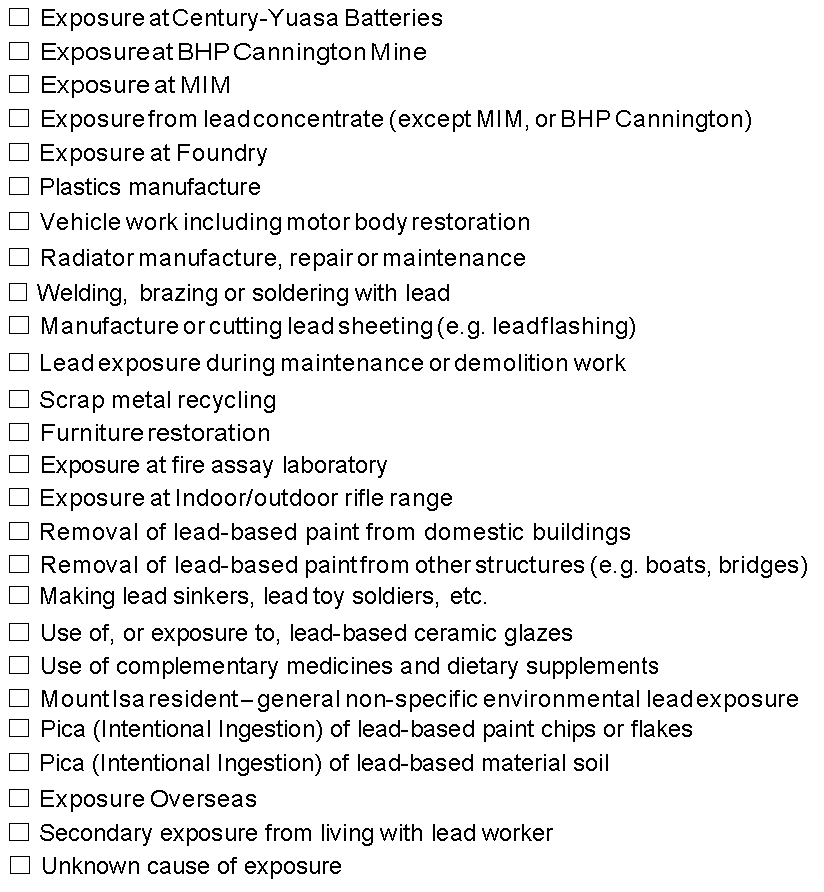
The obvious professions are lead-acid battery manufacturers and lead acid battery recyclers. The recyclers in particular also have to deal with old battery acid which is full of soluble lead salts. Old lead acid batteries are possibly one of the more dangerous causes of lead poisoning, next to lead paint of course.
Then there are welders who remove lead paint from bridges and structures, who have some of the highest reported rates of occupational lead poisoning?
And painters that renovate old houses. If they’re not poisoning themselves, the paint dust and paint chips they leave lying around will certainly poison children. Renovating old houses is recognized as being dangerous, but unless we have regulations like we have for asbestos, we’ll continue to see painters with notifiable blood lead levels.
We’ve got people who work with stained glass for a living or hobby. Lead-free solders are starting to be used but it’s more expensive so you can guess what happens.
Potters who use lead glazes because of their brilliant colours and then fire the lead glazes are exposed to lead vapour.
Some traditionalist artists still use lead paints to replicate the older colours.
Sheet lead has been used for flashing and even roofing (old churches) for a long time. It’s still being used though it’s being replaced by other materials. Roofers were typically exposed to a lot of lead.
The roofs of old churches have slowly been replaced with new lead, exposing a whole new generation of roofers to lead. Lead when it’s been refined still contains a small amount of Pb210, so if you want lead shielding around super-sensitive radiation counters, you need lead that doesn’t contain Pb 210. Luckily Pb210 has a half-life of about 22 years so you only have to wait a couple of centuries before it’s fit to use.
That’s why old lead roofs were so attractive, get the lead that’s free of Pb210 for the cost of replacing an old roof with a new lead roof. Lead ingots in sunken roman ships are absolute gold if you want ultralow-radioactivity lead.
Plumbers used to use lead solders with copper pipes and brass and copper fittings. Legislation now only allows non-lead solders but there was a recent case where a plumber was found to have used lead solder in hundreds of houses in Queensland because lead solder was cheaper. Considering the health hazards of using lead solders, that plumber may get what he deserves.
Brass has lead added to improve workability, so brass manufacturing ought to be classed as a lead industry, but I suspect it isn’t.
Electronics technicians used to use lead solders, and a lot of hobbyists still do. Stone masons use lead to fix iron railings and fasteners into the carved stone.
Other traditional lead workers were type setters and printers. Panel beaters and restorers of old car are exposed to lead paint when they remove or sand old paint, and lead automotive paint is still used to get the authentic colours of old cars, which then includes spray painters as lead workers because automotive paint can have up to 20% lead.
One unintentional group of people exposed to high levels of lead are opium users. Opium is sold by weight and adding lead carbonate increases the weight quite handily. Breathing in lead fumes or injecting lead concentrate makes opium users almost qualify as lead workers.
The biggest remaining group of lead workers are people who use rifles, shotguns and pistols. Every time a gun is discharged, a fine puff of lead dust is produced. That’s only at the gun end and since the projectile is more often than not lead, you’ll get lead contamination at the other end as well. I’d rather not think about the amount of lead at the end of your average shooting range. Rifle and pistol ranges are some of the most lead-polluted areas on earth. When you consider that one of the effects of higher blood levels is reduced cognitive function, is it safe to let people have guns?
Shooting ranges are the second largest contributor of lead (Pb) to the
environment after the battery industry. For example, annual deposition of Pb bullets from shooting activity has been reported to be approximately 70,000 metric tons across US military ranges. That doesn’t include civilian shooting ranges.
There were 8 lead notifications due to excessive blood lead in Townsville, all from a local shooting range.
There are researchers all over the world that are looking at the serious impact of lead on wildlife because of lead pellets from hunters contaminating nature reserves and the general countryside.
If you shoot wildlife for sport, remember that the lead shot or bullets you use will contaminate whatever you’ve shot. If your hunter friend offers you a wild duck shot he on the weekend, don’t accept it. The lead pellets you spit out when you’re eating the duck have already harmed you.
There is a special class of shooters that are exposed to a lot of lead, and that is soldiers. Unless you get shot, which has obvious disadvantages beyond simple lead poisoning, they’re exposed to a lot of lead.
If you do get shot, the lead fragments the doctors couldn’t get out will give you lead poisoning for the rest of your life. Jacketed rounds are a bit better, but not much if they fragment.
This article in the New York Times ( The Army Thought He Was Faking His Health Issues. Turns Out He Had Chronic Lead Poisoning. – The New York Times (nytimes.com)) outlines the dangers faced by troops., and incidentally the benefits of removing lead with chelation treatment.
With the exception of a small number of soldiers who were lucky enough to be diagnosed with excessive lead in their bodies, chelation is rarely used in lead industries to protect workers. It ought to be, but it isn’t.
After all, according to modern medical wisdom, removal of lead from the body using chelating agents is too risky.
Makes you wonder about the Australian Defense Force.
Some countries are more enlightened when it comes to realising that carrying a lot of lead around in your body is a bad thing, and it ought to be removed, but they’re not English-speaking countries as a rule, at least not as a first language. If you don’t live in Italy or India or China, good luck.
I’d like to finish this up with some examples of another group of people exposed to high lead levels that have nothing to do with occupations. Children are people, right?
The tonnes of lead in and on older Australian homes remain a potent source of this neurotoxin, and paint remains an occupational hazard. Renovating an old house where lead paint was used is not only dangerous to the renovators, a pre-1980s house that’s being sanded can release kilograms of lead dust into the surrounding area and if there are children nearby, they are at grave risk.
Would it make you feel better to know there are thousands of Housing Commision hoses that were built, and painted with lead paint, before 1980?
There are two stories about children that really started me on my little crusade about lead, which to be honest feels more like Don Quixote fighting windmills. He thought he was attacking giants with long arms, I’m attacking sloth and indifferenece.
Sorry. The first story is a YouTube video presented by the principal of a school in New York state. https://www.youtube.com/watch?v=mSwHSE6_ZoI
The second is an e-book by a mother, Nancy Hallaway, in British Columbia (Canada) about her experiences with what turned out to be lead poisoning in her twins, caused by renovating an old house. https://www.amazon.com.au/Autism-ADD-Lead-Poisoning-Turning-ebook/dp/B09KS1HF62. The really telling part is that this was originally written in 1992 and nothing significant has changed as far as Paediatrics is concerned.
The UNICEF report, “The Toxic Truth” is pretty confronting as well. https://www.unicef.org/reports/toxic-truth-childrens-exposure-to-lead-pollution-2020
When you get to the map of lead levels around the world, Australia looks pretty good. But that’s because there’s no data on lead poisoning. That’s because there is next to no non-occupational testing for lead. In fact, Queensland Health stopped publishing how many people were affected by lead (non-occupational) after 2015.
Queensland Health as a whole doesn’t do anything to reduce lead levels in children who are deemed to have non-toxic levels of lead, that is blood lead levels below 45ug/dl. Auditing and counseling just doesn’t do enough in the absence of purposeful direction for GPs. We need to deal with lead that has already been absorbed, that is doing harm or that will do harm, particularly in young children.
We’ve got to lift our game reducing harm in children that have already been exposed to lead, so I had to start with people where lead is a close and present danger. You. I have a book about lead tilted “Brush with Death”. Unfortunately the title is to the point.
I do hope I can accomplish something to make sure no child in Queensland is disadvantaged because of lead exposure. That seems pretty unlikely at the moment, but I have to try. Always provided I can get Queensland Health to realise they have a solvable problem. Wish me luck because I’ll need it.
 Lead in Australia - what you didn't know