Australia has a long history of recognizing the effects of lead on children.
It has an equally long history of special interest groups trying to modify public awareness of the effects of lead, to reduce the perception of the dangers posed by lead to our children and to ourselves. In the 1930s it was the lead industry cartel.
I’d encourage watching a short YouTube video by Professor Mark Patrick Taylor who is now the Chief Scient of the Victorian EPA (https://www.youtube.com/watch?v=giKPKiMydms). He makes some points that are worth repeating: the most vulnerable part of the population when it comes to lead poisoning is children, and children are our future.
It’s very hard to assess the degree of lead exposure of a child because the only indicators we have are internal, usually blood lead levels (BLL). As a result there is now a massive amount of medical, scientific, and epidemiological data about the increasing harm caused by lead as a child’s BLL increases.
BLL increases are accompanied by depressed neurological function, including reductions in cognitive function (learning and memory), altered behavior and mood (attention, hyperactivity, impulsivity, irritably, delinquency), and altered neuromotor and neurosensory function (visual-motor integration, dexterity, postural sway, changes in hearing and visual thresholds). Many of these been associated with BLL levels of 5-10ug/dl, which have been observed many times in children in our more lead contaminated cities.
There appears to be no “safe” level for lead when it come to exposure of children, especially infants 0-4 years of age.
Please, please take the time to watch Ralph Spezio’s YouTube video (https://www.youtube.com/watch?v=mSwHSE6_ZoI) because it will absolutely put things into perspective for you about what lead exposure can do to children, whether you live in Mount Isa or Townsville or Broken Hill or Port Pirie or not. If your farm is near the Cadia Gold mine, or you live in Esperance, the children he is talking about could be yours.
He is talking about levels of blood lead that our medical authorities define as non-clinical, and therefore no attempt is made to reduce a child’s body lead levels.
The only place where I disagree with Ralph is where he says the effects of lead in children are permanent. Some of the effects can be reversed, particularly the ones presenting as behavioural and learning problems. Some lead damage is reversible either through appropriate educational therapies, and some by removing the lead.
One possible argument that has been used to justify doing nothing is that most, almost all the data about lead and it’s effects are from somewhere other than Australia. That implies that Australian children are special, which they are, but also that they are possibly more “immune” to the effects of lead, which they aren’t. Or maybe it indicates that Australia values it’s children less.
The table below uses data that is almost 10 years old, but it’s interesting nonetheless.
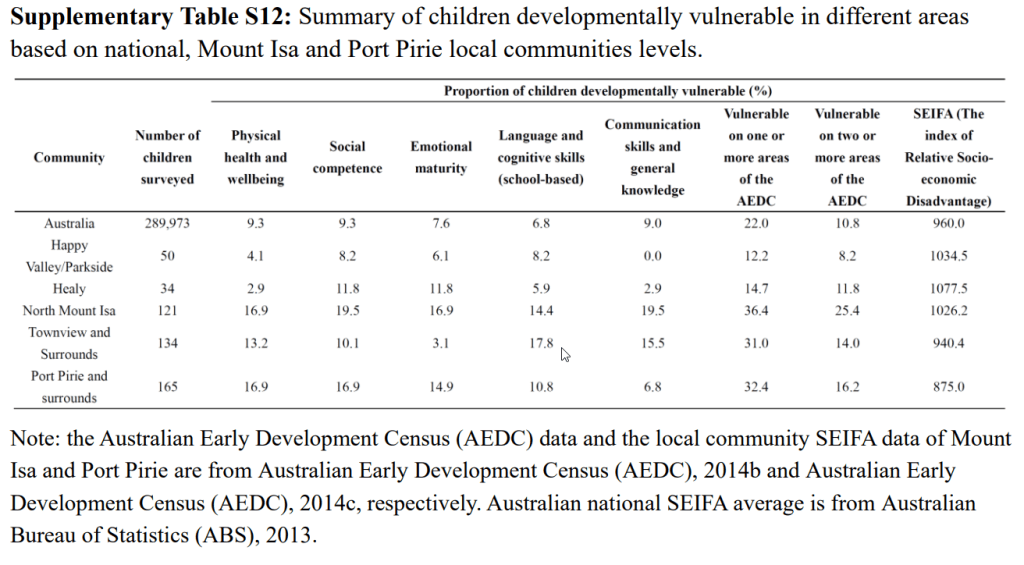
The percentages indicate how much the various categories measured are different to the Australian norm. The bigger the number, the more affected that population of children is by lead. The data is mostly about Port Pirie and Mt Isa, but it includes Townsville because areas of Townsville near the port have been polluted by lead from Mt Isa for the past 90 years.
Then I’d like borrow some quotes from a way-too complex article that is full of useful information (pharmacokinetic model of lead absorption and calcium competitive dynamics (https://doi.org/10.1038/s41598-019-50654-7)).
I’m going to quote parts of the section on age dependence and effects in children (the bolding is mine):
Health effects include anaemia, renal alterations, impaired metabolism of vitamin D , growth retardation, delayed puberty. Exposure to lead during childhood is also well-known to result in neurobehavioral effects that persist into adulthood and may not be evident until a later stage of development (making difficult a correlation, or a precise quantitative assessment of these effects). Delays or impairment in neurological and neurobehavioral development have been noted even at very low doses, and include encephalopathy, lower cognitive performance, neuropsychiatric disorders such as attention deficit hyperactivity disorder and antisocial behaviour.
While toxicokinetics of lead in children appears to be similar to that in adults, the action of many xenobiotic metabolizing enzymes seem to depend on developmental stage. This leads to the children’s increased susceptibility to toxic effects of lead or to detoxification, although the exact mechanisms of this sensitivity is not completely understood. Children and adults may differ in their capacity to repair damage from the deleterious effects of lead poisoning. However, it is important to note that children also have a longer remaining lifetime in which to express damage from toxic exposure.
The closing comment is a bit cruel, suggesting children will be around longer to appreciate the effects of lead exposure.
To bring the information a bit closer to home I recommend you read Nancy Hallaway’s e-book (https://www.amazon.com.au/Autism-ADD-Lead-Poisoning-Turning-ebook/dp/B09KS1HF62). It will cost you $8 to download from Amazon, and it will be the best thing you’ve read if you’re at all curious about what lead exposure can do to children. Nancy’s twins were poisoned with lead when their parents renovated an old house painted with lead paint.
In Nancy’s story, removing the lead by using oral chelation therapy resulted in a profound improvement in her twins behaviour. This absolutely make the point that some of the effects are reversible if the lead is removed. It’s a pity that most doctors don’t understand that.
In case you think that couldn’t happen here, ANY home in Australia that was built before the 1970s is likely to be covered in lead paint. That probably fits a lot of the public housing initiatives in Australia. You could be living next door to one. It some ways lead is a worse danger than asbestos, particularly to children, but aside from some warning, there is no legislation in place to encourage the safe handling of lead paint.
There is an extensive review of the relationship between lead levels and youth crime (Talayero MJ, Robbins CR, Smith ER, Santos-Burgoa C (2023) The association between lead exposure and crime: A systematic review. PLOS Glob Public Health 3(8)) that has a few things worth repeating:
Children do not absorb or metabolize lead in the same way as adults and are far more susceptible to the negative impacts of lead exposure due to a hyper-permeable blood-brain barrier and rapidly developing organ systems [88–90]. Animal studies have demonstrated adverse neurobehavioral effects in animals exposed to lead [10, 11], and multiple ecological studies have demonstrated an association between lead exposure and criminal behavior [7–9, 16]. This review demonstrates an association between exposure to lead and the later development of delinquent, antisocial, and criminal behavior.
In young adults the lead induced antisocial behaviour manifests itself as increased youth crime and violence. Does that possibly ring a bell for people who live in Mt Isa or Townsville? Or suggest that jail or youth detention might not be the only solution? We treat all sorts of mental conditions with drugs, but we refuse to treat lead-affected youth offenders with chelators.
Actually that statement isn’t quite fair, because by not testing youth offenders for blood lead levels, we have no idea they’re lead-affected.
The last commentary comes from a short article that relates to the tragedy at Flint Michigan when officials trying to save money ended up poisoning the adults and children of Flint with lead.
The effects of lead poisoning are not usually detected in a short visit with a doctor. The population impacts are, however, staggering. The consequences are one or two more kids in each classroom with symptoms of attention deficit hyperactivity disorder, 10 or 15 more kids in each school in special education programs, and fewer kids who are truly gifted. A five-point reduction in average IQ caused by widespread exposure to lead
will result in a 50% increase in the number of children with IQ scores below 70 and a 50% decrease in the number with IQs higher than 130. In adults,
lead exposure results in cardiovascular and kidney problems. And some studies have shown that children exposed to lead are at increased risk for school failure, unemployment, and incarceration.
I know you’re hearing the same message over and over again, but you need to appreciate that there are children, thousands of children, in Australia who have been or are being exposed to lead, who have been and are being harmed and who are not treated. We at the very least need to make certain that exposure to lead is reduced as much as possible. Educating our doctors to test for blood lead and realise that lead causes harm wouldn’t hurt either.
A last comment, paraphrased from Mark Taylor is that the companies that mine, smelt and use lead may have licenses to pollute, which is the end result of setting pollution limits. You’re allowed to pollute, but not too much. But they are not licensed to poison our children.
 Lead in Australia - what you didn't know