An article has been published in the Lancet, it’s title is ” Global health burden and cost of lead exposure in children and adults: a health impact and economic modelling analysis” (Global health burden and cost of lead exposure in children and adults: a health impact and economic modelling analysis (thelancet.com))
It doesn’t say a lot more than I’ve said already but if you want an authoritative article about the harm from lead exposure, then this is almost rates. Let’s look at some of the figures:
The first is on the relationship between Blood lead level and loss of IQ in children. Losing 10 IQ points doesn’t seem like a big deal until you realise that it could be the difference between an adult coping with life and one that can’t.
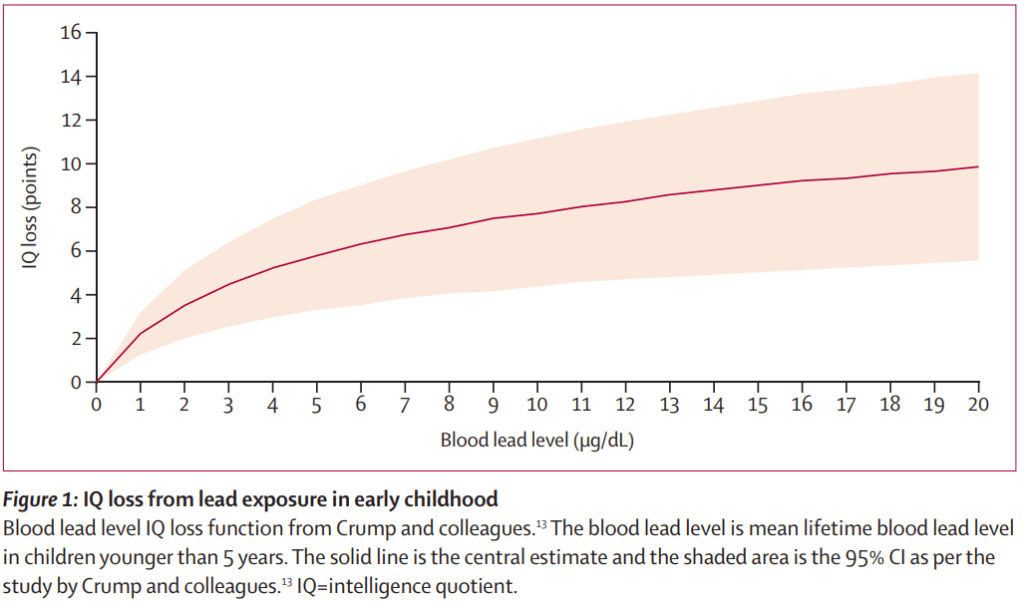
The last time a group of children in Mt Isa had their blood lead levels tested almost 6 years ago, a fair percentage had BLL over 10ug/dl, some higher, though those were predominantly aboriginal and islander children. I had a cartoon in one of my earlier blogs that summarised this quite nicely.
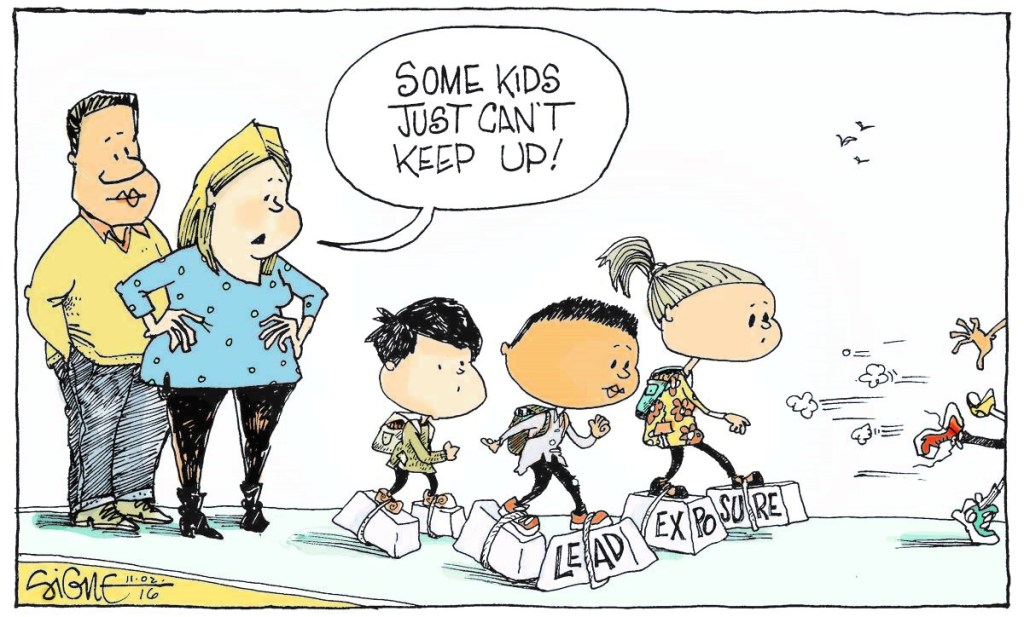
If the BLL isn’t too high, affected kids will just be a bit slower, not quite as quick in picking things up. They’ll find school difficult and the school might very well find them difficult. They’ll be no smarter when they grow up, just even more difficult. Some of them will end up in jail because of the effects of lead. Not bad parenting, not bad genes, not a failure in the education system or the local community, but lead exposure.
I’d like to quote a short part of an article written by pediatricians about lead poisoning in Flint, Michigan and the effect of a drop in IQ caused by lead:
The effects of lead poisoning are not usually detected in a short visit with a doctor. The population impacts are, however, staggering. The consequences are one or two more kids in each classroom with symptoms of attention deficit hyperactivity disorder, 10 or 15 more kids in each school in special education programs, and fewer kids who are truly gifted. A five-point reduction in average IQ caused by widespread exposure to lead will result in a 50% increase in the number of children with IQ scores below 70 and a 50% decrease in the number with IQs higher than 130. In adults, lead exposure results in cardiovascular and kidney problems. And some studies have shown that children exposed to lead are at increased risk for school failure, unemployment, and incarceration.
We have children handicapped by lead exposure and despite knowledge that these children could potentially be helped, our health services do nothing. By nothing I don’t mean not necessarily removing lead but not doing any sort of rehabilitation. The human brain is wonderfully flexible and adaptable and with help a lot of degenerative defects can be worked around. But not even that is happening.
Actually, that statement isn’t quite accurate because there are a few clinics where an awareness of the effects of lead exists, and the benefits of lead removal are practiced. But good luck finding one.
My kids are grown up, and I haven’t been blessed with grandchildren, but if I did have grandchildren and they were living in Mt Isa, I suspect I’d be doing more than just writing a blog.
Let’s look at the graph of BLL vs cardiovascular mortality in adults. Nothing new here, but maybe a picture is better. This isn’t about cardiovascular disease which won’t necessarily kill you, this is about the risk of DYING of cardiovascular disease as your blood lead increases.
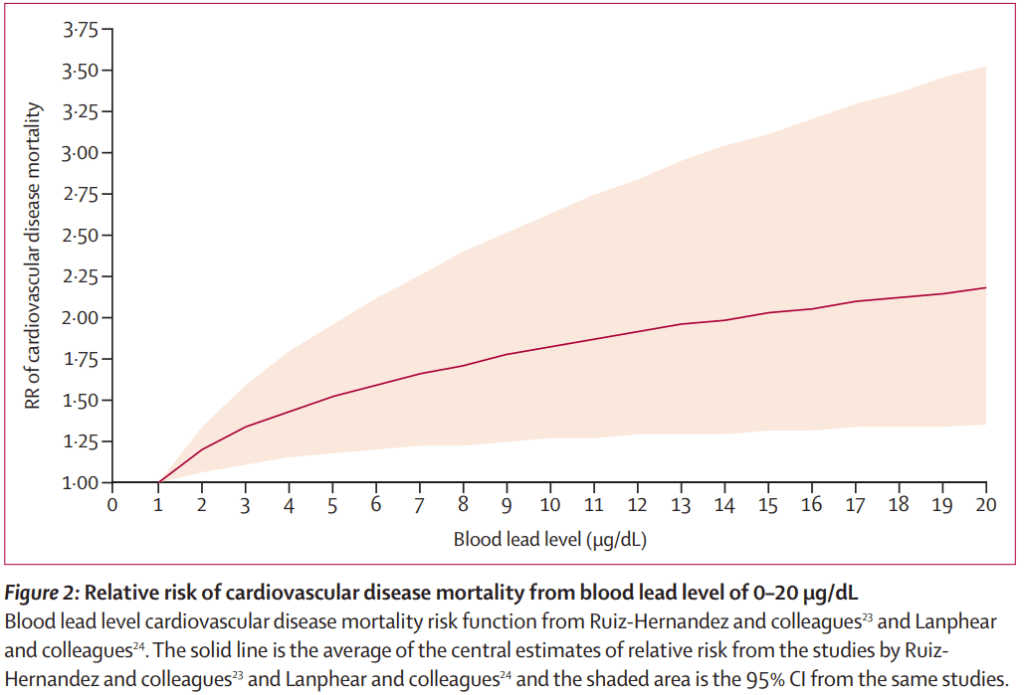
The scale on the left isn’t percentage it’s something called relative risk. At a BLL of 10 ug/dl, you have a 1.75 times greater risk of dying of cardiovascular disease, at 20ug/dl you have a 2 times better chance od dying of cardiovascular disease, and extrapolating to 30 ug/dl, that goes up to about 3 times. Are you really okay with having a BLL between 10-20 ug/dl? Are you silly enough to think that’s safe?
Think about hardening of the arteries, or maybe getting a foot amputated because of peripheral vascular disease and diabetes. If that’s not too thrilling, think about whether something could be done, which it can.
The picture below is of the foot of an 81-year old man with peripheral vascular disease and diabetes. His foot is just at the stage where amputation is going to be the next option.
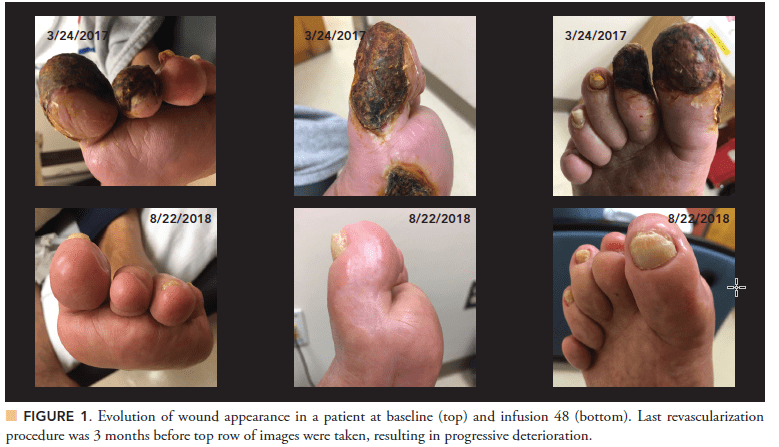
On the top you’ve got quite obvious gangrenous toes where the foot was so painful the man couldn’t walk anymore. On the bottom you’ve got a healthy foot that is still attached, and able to be walked on. I think that’s pretty cool.
I pointed out that a Monash University study found a 7 times greater risk of oesophageal cancer at 30ug/dl BLL. That can result in also having your tongue cut out. Why would anyone be willing to risk that if they didn’t have to.
The Lancet article goes on to provide data for calculating the economic cost of lead exposure. There’s a lot of mathematical analyses, but the bottom line is that the economic cost of lead exposure is pretty massive. That makes the cost benefit analysis of removing lead versus doing nothing pretty conclusive.
And still we do nothing.
I’ll include a few direct quotes from the article:
The estimate of the global health burden of lead exposure in this study places lead exposure as an environmental risk factor at par with PM2·5 ambient and household air pollution combined, and ahead of unsafe household drinking water, sanitation, and handwashing
This states lead exposure beats air pollution when it comes to health costs. Doing something about exposure to lead is more imporatnt than safe drinking water or sanitation? You’ve got to be kidding, right?
Then again we don’t do anything about air pollution in Australia for the most part. Doesn’t it make you proud to realise we don’t give a damn about a lot of things that impact our health? Is that stoic or stupid?
The quote about LMICs below includes Austrlia. An LMIC is a low-to-middle-income-country.
A central implication for future research and policy is that LMICs bear an extraordinarily large share of the health and cost burden of lead exposure; consequently, improved quality of blood lead level measurements, lead exposure identification, research, policies, and practices are very urgently needed to
address that burden.
Come on, we know what’s needed, health services that have an awareness of the dangers of lead, an awareness that lead is a causative factor in a lot of degenerative diseases and an awareness that sub-clinical lead poisoning needs to be treated.
If Queensland Health was on the ball, they’d have something to say about the flawed WHS policies. Actually F__KED WHS policies is a more apt description but we need to be a bit genteel here in case our authorities are too sensitive.
Well, I’ll try to end the year again.
Merry Christmas and a Happy New Year. Let’s hope something magic happens and we see a solution to this crazy WHS situation that keeps making things worse for people exposed to lead.
 Lead in Australia - what you didn't know