I thought I’d write this to put together a guide of sorts on how to avoid lead poisoning in a lead-rich environment. The lead-rich definition is fairly broad because it includes occupational lead, environmental lead, whether natural or due to lead pollution and things like lead paint on old (pre-1970 construction) buildings and even old buses and cars. It includes lead pollution from old car batteries, lead flashing on roofs, lead solder on old water tanks and a lot more.
It’ll take a while to complete this guide so please understand it’s a work in progress. As for me, I’m retired, but I have a PhD in Medicine, spent 14 years in medical research studying aspects of metal metabolism in animals and humans, and I have had the luxury of spending a lot of time finding out as much as I could about lead. What I’ve found is frightening, but it’s pretty clear that the effects of lead can be minimized or avoided, which is kind of why I’m writing this.
INTRODUCTION
Broadly speaking the first thing you need to appreciate is just how subtle and dangerous exposure to lead can be, and how long it can take before you get significant symptoms that are recognized as due to lead exposure. While you’ll get pretty obvious symptoms if you cop a large dose of lead, it takes a long time for anything but neurological symptoms to show up.
Insomnia, loss of appetite, decreased libido, depression, irritability, memory loss and headaches just aren’t seen as symptoms of something like sub-clinical lead poisoning. You can also get neurological symptoms that look like MS, or Parkinson’s or dementia but you can bet they probably won’t test for lead either.
If you’ve got young children, then I would strongly suggest you get and read a copy of Nancy Hallaway’s kindle e-book (From Amazon, $8), “Autism, ADD, or Lead Poisoning? Turning Lead into Gold”. It will frighten you, but also give you an appreciation of the potentially devastating effects of lead on young children. It will also inform you that at least some of the deleterious effects of lead are reversible, and that’s a theme I will bring up again and again. While some of the effects of lead are irreversible, some aren’t.
Also take the time to watch Ralph Spezio’s YouTube video (https://www.youtube.com/watch?v=mSwHSE6_ZoI) because it will absolutely put things into perspective for you about what lead exposure can do to children. Ralph Spezio is talking about relatively low levels of lead, around 10ug/dl which have been detected in a reasonable percentage of children tested in Mt Isa, as an example. This video could be about your kids!
Lead is dangerous when it gets into your body. Lead ore dust , often lead sulphide (galena), is an insoluble form of lead. But if the dust gets into your body, it gets converted into a soluble form of lead which is avidly taken up into your body. Organic acids like vinegar are a great way to make lead soluble. Lead acetate used to be called “supa” by the Romans and was used to sweeten food and wine.
Adults will absorb up to 10% of ingested lead, infants up to 40% of the lead because of a greater need for calcium. The mechanisms that handle calcium uptake and deposition, do the same with lead.
Lead accumulates in the body as exposure continues and very little leaves your body unless something like gestation or breast-feeding liberates calcium and therefore lead from the mother’s body to her baby. That’s not giving your child a very good start in life and in my mind represents the absolute worst case scenario, a child born with lead poisoning.
The accumulation of lead is called bioaccumulation and most of the lead you absorb will end up in your bones, with some in teeth in infants and a good bit in your brain. As the total amount of lead stored in your body increases so do disease states caused by lead, especially neurological diseases.
In the USA the CDC estimates that there are up to 400,000 lead comorbidities every year, that is deaths where lead was a contributor. There’s little reason to think the situation in Australia is much better. There could be up to 35,000-40,000 Australians a year dying because of the effects of lead. I bet you weren’t aware of that possibility. Didn’t they tell you?
The effects of lead in infants is much more extreme, partly because of the higher intake of lead, and partly because the developing brain is much more susceptible to the effects of lead. Relatively low levels of lead, below the notification point where our health authorities are “supposed” to take some action, still have profound neurological effects. Miniscule (nanomolar) amounts of lead in an infants brain will affect their learning capacity and behaviour.
The CDC also estimates that 1 in 6 children the in the US are affected by lead. There’s little reason to think the statistics in Australia are that much better because we have no data on the incidence of raised lead levels in the general child population.
Things could even be worse in Australia because unlike the US, non-occupational blood lead testing is discouraged. It is likely that less than 1 in 2000 (that’s 0.05%) of the general population has been tested for lead exposure. If you don’t test for lead, you won’t find it.
We have multiple problems in our medical services: a lack of wide-spread awareness of the dangers of lead, a lack of appreciation of the contribution of lead to disease processes, a lack of appreciation that excess lead can and should be safely removed and as a result, a lack of testing for the presence of lead.
We had nearly 50 years of being told that leaded petrol was safe, and while we mustn’t discount the influence of the mining companies, and bureaucratic inertia, I’m sure that’s a factor in the lack of appreciation that lead represents a massive public health failure.
It’s a sad reality that we probably can’t depend on our politicians or medical services to protect people from the medical outcomes of lead exposure. Even the workplace health and safety organizations get a big FAIL when it comes to protecting lead workers from lead biohazards. In the absence of due care and in the presence of almost criminal negligence, we’re left with the reality that we have to take care of ourselves when it comes to lead.
There are 3 parts to protecting yourself from lead; detecting what is lead-contaminated, reducing exposure as much as possible, and where exposure is unavoidable, doing something to remove the lead before it does permanent harm.
Part 1 – Lead Detection
If we stick to talking about stuff that’s relevant today, then there are 3 technologies that are suitable for detecting lead contamination.
The first is ICP-MS, inductively coupled plasma mass spectrometry. ICP-MS can be used to measure lead (and other heavy metals) content in blood and just about anything else provided it is digested in acid beforehand. It is very sensitive and there are many pathology and analytical services with ICP-MS.
Blood lead levels (PbB or BLL) are measured using ICP-MS and the cost of the test is a bit over $30. Medicare actively discourages blood tests unless there are symptoms suggesting lead exposure. That little gem comes thanks to a 2015 NHMRC report that recommended against widespread blood lead testing and so the smart people at Medicare will do things like threaten to rescind a doctor’s Medicare provider number if he orders any “unnecessary” blood lead tests. Of course, if you’re willing to pay the $30 yourself, there’s nothing stopping you getting your doctor to send a blood or urine sample to an analytical or pathology lab for lead testing.
If you want to find out the lead content in something like paint, or soil samples, then the traditional way to do that is send the sample to an analytical lab, pay your money and get the results of chemical measurement of lead. Chemical estimation of lead has probably mostly been replaced by ICP-MS, but it’s still out there.
You can get personal lead test swabs, which are inexpensive ($18 for 30 on eBay) but they’re really only intended for relatively high levels of lead, like that found in lead paint. But if the test swab does detect anything, it’s serious.
The third way to measure lead is relatively new from the viewpoint of affordability and medical use. It’s X-ray fluorescence spectrometry (XRF) and it works by exposing a sample to a small amount of x-rays, and measuring the fluorescent x-rays given off. XRF is fast, noninvasive and is extensively used in the mining and metallurgy industry because you can determine things like alloy composition. Once it’s calibrated, anyone can potentially use an XRF like an oversize infrared thermometer, but XRF gives you metal content, not temperature.
XRF is also used in a lot of other scenarios, for example by Curtin University researchers to measure lead levels in wildlife, in the Vegesafe program that tests soil, and even at Taronga Park Zoo where it is used to determine an animal’s provenance by looking at a fingerprint of metals.. XRF spectrometers can be hired in Melbourne and Perth to test for things like determining the concentration of lead in auto paint.
There’s an interesting lady, Tamara Rubin, who has a website LeadSafeMama (https://tamararubin.com) where she posts the results of testing the lead content of just about anything with her own personal XRF spectrometer.
XRF can also be used to measure the amount of lead in bones. Recent work by researchers at Purdue University have used a special portable XRF spectrometer that’s been calibrated to estimate bone lead. Remember that up to 95% of the lead in your body ends up in bone, so measuring bone lead gives you a pretty good idea of the amount of lead in your body and the risk to your health.
XRF is a game-changer for reducing exposure to lead because if you have access to one, YOU can measure the amount of lead in whatever you want. In the dust in your attic, the soil in your garden, where your kids play and so on.
Imagine being able to identify any lead hazards yourself without having to depend on an external testing lab or external agencies.
Maybe your community could crowd-fund an XRF Spectrometer. Contact Tamara Rubin (Tamararubin.com) for advice on her collaborative community project to fund getting an XRF spectrometer.
2. Protection
If you live in a lead-rich area, either due to natural ores or pollution, or near a mine, lead ore dust is an inevitable part of the environment. The dust will contaminate your water tanks, lead will contaminate the plants you grow in lead-contaminated soil and lead will contaminate animals that are raised on lead contaminated soil.
There are suburbs in Melbourne and Sydney where lead contamination due to leaded petrol means it’s not safe to eat the vegetables you grow. There are cattle stations in North Queensland that had their cattle rejected for live export to Indonesia because of high lead levels. Cattle for export now have their lead removed and I dearly hope that happens for cattle for domestic consumption as well. There are new housing developments in areas that are likely lead-contaminated, like the sites around old lead smelters.
We need strategies for dealing with the dust, for getting lead free water and vegetables, and hopefully doing the same for our food animals.
The Living with Lead alliance in Mt Isa instigated a program where particularly contaminated yards were concreted over, with articial turf on top. But that’s not really a terribly practical solution.
Keeping your houses relatively dust free helps a lot, but adding an air purifier in the house to reduce circulating dust in the air, wearing dust masks when doing anything that raises dust, like mowing the lawn, are all useful.
Another interesting strategy that is used for lead (and other heavy metal) neutralization in industry is a chelating agent called TMT (1,3,5 trimercapto 2,4,6 trazine). TMT is used to wash flue gases in some smelters to bind to lead and form an almost inert complex that is apparently biologically inert. There might be quite a market in a commercial cleaning product ontaining TMT, named something like “Get the lead out”.
If you have a pre-1970s house, the paint can be hideously dangerous to children because lead paint has a sweet taste that is irresistible to children and animals. Licking paint has killed children in the past. It’s incredibly nasty. At least some of the older public housing in Mt Isa has lead paint, and yards full of lead paint dust and chips from flaking paint or sanding.
My aunt has an old house that was covered in lead paint. I’ve never approved of PVC siding, but if it covers up lead paint, it’s more than acceptable. Have I stressed that lead paint is really dangerous?
Before you panic or spend money you don’t have to, you can get the soil and dust around your house analysed for toxic metals at low cost (donations appreciated). There are two available options, Macquarie University’s Vegesafe and Dustsafe programs (https://www.mq.edu.au/faculty-of-science-and-engineering/departments-and-schools/school-of-natural-sciences/our-research/impact-case-studies/vegesafe-and-dustsafe, and the Victorian EPA’s Gardensafe program (https://www.360dustanalysis.com/) which may only be available for Victorian residents.
The data from the testing programs is shared as part of a global environment mapping effort (Map My Environment: Global (shinyapps.io)), which would be wonderfully subversive for your group if you can get enough local residents to take part.
If raised levels of lead are detected, then here’s what to do.
Water from rain water tanks needs special attention because the pH of the water will influence lead bioavailability as will any bacteria in the sludge at the bottom of the tank. Some of the lead in rainwater is still in the form of dust, some may have been converted to soluble lead by microbial action.
I’ll quote part of SA Health’s commentary on lead in rainwater in Port Pirie where lead contamination is still all too common:
Rainwater in Port Pirie contains lead. Studies have shown that contamination can be at levels high enough to cause serious health concerns or poisoning if drinking rainwater or using it in any circumstance where the end product is consumed. This risk can be easily avoided by drinking and using mains or bottled water.
Drinking contaminated rainwater is one of the ways lead can enter your body. Together with other exposure sources around Port Pirie, consuming rainwater can cause elevated blood lead levels, often above the National Health and Medical Research Council (NHMRC) recommended exposure investigation level of five micrograms per decilitre (μg/dL).
Pregnant women and young children should not use or drink rainwater collected in Port Pirie.
Once you filter out the lead dust, which is relatively easy, the least expensive way to remove soluble lead is with an ion exchange column (mixed bed, cations and anions) or cation (metal ions only) . This YouTube video shows how to deal with mixed ion exchange resin ( https://www.youtube.com/watch?v=Zij-PwFHvBA). A cation exchange column can be more easily regenerated with hydrochloric acid. A colour-changing resin would let you know when it needs to be regenerated (Deep Green Cation Ion Resin CSP10 – A&C Pure Water Treatment (ancpurewater.com)
Reverse osmosis will remove lead as well and it has a higher water throughput. Depending on your needs this may be a better choice, but it’s also more much expensive. There is some evidence that zeolites remove lead but I haven’t got all the relevant information.
Rain water, lead or not, has relatively few salts so if you’re used to drinking rain water the lack of salts won’t bother you. Otherwise ,you might want to add some salts to the purified water for taste. In any event, an occasional metal/salt supplement isn’t a bad idea in any case.
Lead in food is a challenge if the soil is contaminated.
Gardening Australia has a couple of programs about garden soil safety. The latest on is on ABC iView (Series 35 Summer: Contaminated soil and coastal habitats : ABC iview), where you’ll need a free login, or there’s also an older Gardening Australia YouTube video (Safe Soil – Gardening Australia (abc.net.au)) on safe soil, and soil testing with an XRF spectrometer, by Professor Mark Taylor who is now Victoria’s EPA chief scientist.
If your soil is contaminated with lead, you need to realise that lead paint on a pre-1980s house that has been renovated, will have contaminated the whole area around the house. Lead dust is a minor contributor to the contamination in this case. Growing vegetables in raised garden beds filled with clean soil is the best safe option if soil in your garden is found to be contaminated.
Another option is hydroponic vegetables if you want to avoid any risk of lead contamination AND you have lead-free water.
Lead in animals is harder yet. The example I gave earlier about cattle in North Queensland had a relatively easy solution, The cattle are kept in a feedlot and fed a chelating agent, TMT, and after a few weeks they test free of lead and away they go. As mentioned earlier, TMT is an industrial heavy-metal chelating agent.
Use geofabric as a base for clean soil or sand for your chicken run and you can avoid lead-contaminated eggs.
It’s worth pointing out that animals are also adversely affected by lead. Not as much as humans but that’s because we live longer and can accumulate more lead. I have a story about cattle in a large paddock that also contained an old bus. The cattle weren’t thriving and even after the local veterinarian got involved, nothing was found to explain why the cattle were sickly. Until one day when the farmer spotted one of his cattle licking the old bus. It turns out the bus was painted with lead paint, and when the bus was removed, so did the problems.
But back to what you can do. If you can remove lead that you’ve eaten and absorbed, then that’s nearly as good, and a lot easier, than trying to make your food and environment lead-free. If I was offered a prime eye fillet from North Queensland, I’d enjoy it regardless of whether it contained lead or not because I’ve taken an oral chelating agent.
That’s kind of like a doctor I knew that had type 1 diabetes. When faced with a fabulous dessert, he’d mentally estimate the amount of sugar and inject an appropriate amount of insulin. You can have your cake and eat it too.
3. Lead Removal
This is the big kahuna of dealing with lead using a molecule that specifically forms complexes with metal ions, called a chelator, or chelating agent. A whole lot of things will bind metal ions, but chelators are generally much more specific.
Chelators are used as food additives to reduce spoilage and oxidation, they are used to remove heavy metals from smelter flue gases, and heavy metals from animals and humans.
I’ll give an example.
Lewisite was an arsenic-based chemical warfare agent invented by the British in 1918, too late to be used in WW1. British anti Lewisite (BAL) was developed in 1940 as an antidote and pre-treatment in case Lewisite was used and blown into the allied trenches. Thankfully, Lewisite was never used but BAL turned out to be incredibly useful to treat arsenic poisoning and as such was the first medically used chelation agent. It’s still in use at times.
There are many other chelators, relatively specific for other heavy metals. A number of sulphur-containing chelators work well for removing lead but the most common one in use is EDTA (ethylenediaminetetraacetic acid). EDTA was invented in 1935 but it was first used in the dye industry and as an anticoagulant and subsequently for the treatment of hypercalcemia and eventually lead poisoning.
In the 1950s and 1960 researchers noted that EDTA treatment for lead poisoning also improved vascular disease, causing a huge interest in using EDTA to treat all sorts of cardiovascular problems. With everyone using EDTA and no proper protocols, it was inevitable there would be fatal accidents. Things got so uncontrolled that the use of EDTA was actively discouraged to the point of chelation therapy being banned by some states in the US. The cases of renal damage occurred in the 1950s, the child dying of hypocalcemia was a case of ignorance and negligence, using too high a dose of the wrong form of EDTA.
In 1989, a “Protocol for the Safe and Effective Administration of EDTA” was developed and subsequently updated. The detailed protocol provides strict criteria for patient selection and cautions clinicians to perform an initial evaluation of renal function and to frequently monitor renal function throughout a series of chelation treatments. Emergency procedures are outlined should adverse reactions occur.
The present-day chelation protocols used for the last 30 years or so have been proven to be safe. As I pointed out before, chelation is used to make cattle safe to eat.
But, despite an abundance of current evidence showing that chelation therapy was safe, it has kept it’s stigma in most the Medical industry, being used only when absolutely necessary. If you suffer from severe lead poisoning, then chelation therapy is used. Otherwise it is discouraged, albeit for no good medical reason. With the possible exception of essential metals depletion which can be managed with metal supplements, chelation is safe.
It’s a personal theory of mine that the effectiveness of EDTA chelation therapy threatened the livelihoods of cardiac surgeons, manufacturers of stents and drug companies who make statins, but that’s just a theory to explain why so many otherwise intelligent people would criticize something so useful.
Chelation therapy is now used as a standard treatment for treating any heavy metal toxicity in many parts of the world, but not in Australia for the most part. Then again, the amount of testing for lead and other heavy metal exposure in Australia is minimal. If you’re able to find a clinic that tests for heavy metals and removes them with chelation therapy you’ve been lucky.
Chelation works.
But however useful and safe IV chelation therapy with EDTA might now be, it’s really not all that practical in the general population because of the lack of availability from public medical services and lack of support (no rebate) by Medicare. IV chelation in Australia is quite expensive if you’re not suffering from hypercalcemia or toxic lead poisoning in the public hospital system.
Oral chelators are a better choice since taking a capsule is relatively less complicated and removing lead from bone is a slow process in any case, better suited to smaller doses over a longer period.
Of the oral chelators available that remove lead effectively, I would like to opt for calcium disodium EDTA. DMSA (Dimercapto succinic acid) is probably somewhat more effective because of it’s higher oral absorption and faster removal of brain lead, but it’s 25x more expensive and the TGA has only accredited it for veterinary and radiochemical use.
From an cost viewpoint you can buy 1kg of calcium disodium EDTA powder (food grade) for about $60+freight from bulksupplements.com. That will let you fill a bit over 1600 size 0 capsules. You can buy 2000 empty size 0 capsules which will hold about 600 mg (gelatin $40, enteric coated $92) and a size 0 capsule filling machine ($40) from buyemptycapsules.com.au. The enteric-coated capsules are liable to give you better absorption because stomach acid reduces EDTA salt solubility.
A daily dose of 6oo mg of EDTA will cost you a bit over 13 cents a capsule (enteric coated). You’ll have to fill them yourself, but that’s not too hard with the filling machine (I managed) and it’s a LOT cheaper than buying EDTA capsules online.
That one capsule a day could potentially stop any further accumulation of lead, and might even reduce the amount of lead in your body (albeit slowly).
When I was first looking for current evidence supporting oral chelation, I found a lot of case studies, but nothing relevant to lead-workers. It turns out I didn’t look far enough back. I found a gem, (Williams JD, Matthews GA, Judd AW, Oral Calcium Disodium Versenate in Treatment of Lead Poisoning , Br J Ind Med. 1962 Jul; 19(3): 211–215.). This presents a study of the effects of oral calcium disodium EDTA (Versenate) in workers suffering lead poisoning. It provides a good review of previous work in the 1950s, but more importantly, it indicates the safety and effectiveness of oral EDTA, 60 years ago.
The study used a total of 4 grams of calcium disodium EDTA per day, but my opinion is slow and easy will do a better job of removing bone lead and avoid the trace metal depletion issues discussed below.
The following diagram shows the range of lead concentration that is linked with various blood lead levels.
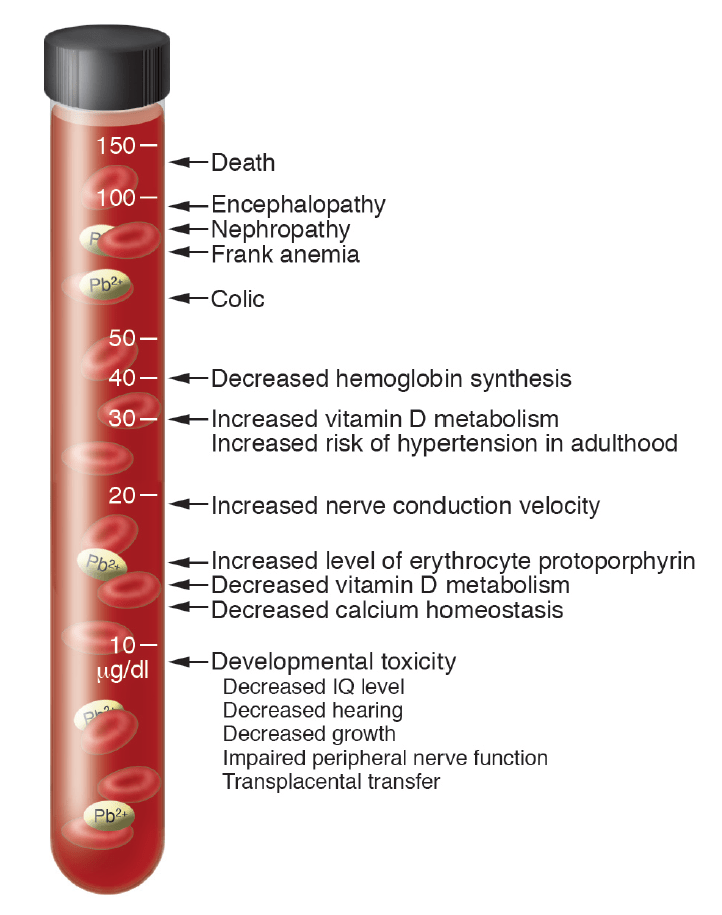
An argument against “prophylactic” lead removal has suggested it is unethical to give someone a “drug” unless they have disease symptoms. And yet how many times have you heard of people being prescribed prophylactic antibiotics, just in case. In any event, if you’ve been exposed to lead or are in a lead-rich environmrnt the symptoms are there, they just haven’t been diagnosed yet.
Look at the diagram below and work out which of the central nervous system symptoms are solely indicative of lead poisoning.

You’ll need to make up your own mind, but that is why there isn’t a standard protocol for oral chelators used prophylactically to prevent lead accumulation.
There are many case studies over many years that used oral chelators effectively and safely to remove lead, but not THE double-blind study that the clinicians insist they need before they’ll change their minds.
But lets run the numbers.
Calcium disodium EDTA is absorbed relatively poorly because of stomach acid, and only about 5% (using C14 labelled EDTA) enters your body. It should be absorbed more effectively if administered in enteric capsules, but let’s stick with that published 5%. If we have a dose of 600mg in a size 0 capsule, then about 30 mg should be absorbed. Calcium disodium EDTA has a molecular weight of 375, and one EDTA molecule will bind one atom of lead (molecular weight 207). That means that 30 mg can theoretically bind and remove (207/375×30) 16 mg of lead. That’s not bad considering that if you ingested 16 mg of lead and you weighed 100kg, your blood lead level would be well over 20ug/dl.
It would be safe to say that you would probably no longer be adding to your lead stores, and that’s pretty good. Always, provided you’ve minimised lead exposure as well, you should be starting to remove lead already in your body.
There are some cautions about regularly taking calcium disodium EDTA. EDTA binds other heavy metals, which is an absolute bonus if you’re a bit older and had mercury amalgam fillings in your teeth, or were using organophosphate insecticides in the past or like seafood (with heavy metals). But EDTA potentially also binds essential metals like magnesium and zinc which can then be depleted. Not a lot because the affinity for lead is greater, but a regular trace metal or zinc and magnesium supplement would be a good idea. Oral EDTA largely leaves the body within a day so a regime where you took EDTA for 6 days and a supplement on the seventh would pretty much keeps things working as needed.
We use calcium disodium EDTA because it exchanges calcium for lead and actually augments the calcium in your body. I’ve read that EDTA will also bind iron. It’s extremely unlikely EDTA will remove iron from your body, I know because my medical research included studying iron uptake. BUT, it could prevent the uptake of iron from your food. That’s great if you’ve got Haemochromatosis but not so good if you’re iron deficient. If you were to take EDTA and ferrous folate, as an example, on alternate days, that would sidestep that issue. EDTA ought to be totally cleared from your body within a day.
If you’re afraid the EDTA will stop you absorbing any of the food grade iron filings added to your favourite breakfast cereal, I can assure you that very little elemental iron is absorbed in any case, so EDTA most likely wouldn’t make any difference. If you’re a Vegan, I’m sorry to report that you won’t find many sources of bioavailable iron. That includes the fairytale of iron in spinach.
In summary, provided you manage potential essential trace metal depletion, oral calcium disodium EDTA is safe. In my book if you’ve got demonstrable lead on board (take 1 capsule, take a 12 hour urine sample and get it analysed)., you have absolute proof of lead that needs to be removed.
That’s it for now, more to come as I find time.
There is a lot more information in the many blog posts below so if you’ve got time, PLEASE READ THEM because you’ll learn a lot more they didn’t tell you about lead.!
 Lead in Australia - what you didn't know