I’ll be up front about the fact that I am convinced that excess exposure to lead has long term adverse health outcomes. Nothing I’ve read suggests that lead is safe so be warned. On the other hand, I also think that with the proper measures, living with lead could be safe, but those measure aren’t yet being applied in Mt Isa or most other places in Australia.
If you live in a lead-rich environment like Mt Isa, there is always the potential that children can be exposed to and absorb lead. Good hygiene and good health and diet will reduce the amount of lead that is absorbed. Making sure children don’t play in the dirt and keeping the house dust free will help as well, but the risks of lead absorption are only reduced, not absent.
If you’re careful and observant enough, the risks of lead affecting your children can be minimised, although never completely. Lead safety takes a lot of vigilance, and a lot of care. It takes something else as well, an appreciation of the fact that situations can arise where all your care and vigilance won’t be enough.
The biggest dangers are complacency and denial.
Half of the people interviewed in a James Cook University study in Mt Isa indicated that lead wasn’t a health risk, and they were often people who were born and raised in Mt Isa. No level of lead in your body is safe, and the only real question is how much risk people are prepared to ignore.
I think it’s better to say that you need to know your enemies, understand them, before you can decide if they’re harmless or not. That avoids nasty surprises.
I absolutely understand that the presence of lead is associated with the prosperity of the city, with jobs and careers, with property values and with the economic wellbeing of the community. It would be silly to suggest that lead isn’t an incredibly important part of the lifeblood of the community. But that doesn’t mean it should be in the bloodstream of people in the community as well. My only goal is to reduce the very real risks of adverse health outcomes in Mt Isa.
I also can’t ignore human nature because acknowledging the dangers of lead when you’ve ignored them in the past involves some uncomfortable self-analysis that most people will try to avoid. The denial concerning lead can extend to harassing people who are publicly outspoken about the dangers of lead and this can get really uncomfortable for people who have a genuine concern, because at some level they are seen by some as a potential danger to the community as a whole.
And then there are people who generally don’t have a voice regardless.
These are people, who because of their socio-economic circumstances, don’t have the same opportunities to avoid lead exposure to their children. People who live in older pre-1980 houses or lead-painted social housing, whose diet means that their children are even more likely to be iron and calcium deficient. People who don’t have grass-covered back yards and where dirt is the only play area for their children. The fact that their children are at much greater risk of lead poisoning because iron deficiency and lead poisoning go hand in hand, and calcium deficiency increases the amount of lead absorbed is generally overlooked.
Let’s face it, every study of blood lead levels carried out in Mt isa has shown that indigenous children have higher blood lead levels and are more at risk of lead poisoning.
So, the big question that has to be answered is whether leaving things as they are, or trying to improve them, is the best long-term strategy. But change can be difficult, though the end result can be so much better.
Active community involvement in minimising the risk of lead exposure makes an enormous difference, but that’s pretty hard in a community in denial. There are programs, Vegesafe and Dustsafe, sponsored by Macquarie University, that will analyze soil and dust samples sent in by people who want to find out if their yards are safe. The data is then made available in a global environmental database, (Map My Environment: Global (shinyapps.io).
Let’s compare Broken Hill and Mt Isa:
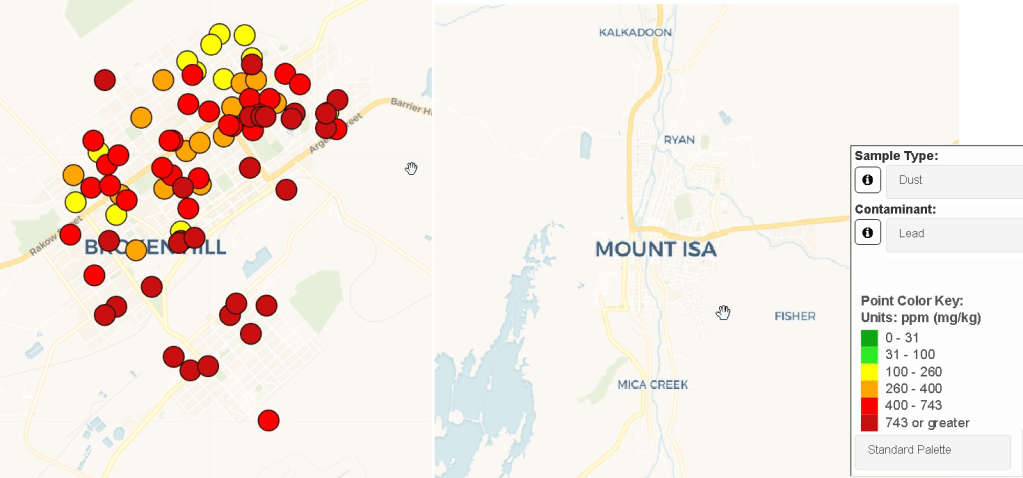
Guess which community is in less interested in lead contamination and which one is taking an active role in detecting and minimizing lead exposure. If you don’t do the tests, you don’t know the truth, and it may not be what you think.
Do the people of Mt Isa honestly believe they have a safer environment than a lead mining city like Broken Hill that doesn’t have a smelter? Where ore is shipped to Port Pirie instead of being ground up a processed into lead concentrate for the smelter or export from Townsville?
Unless the Mt Isa community actually starts taking an active role in lead risk management, and not just leaving things to the city council and the Lead Alliance, they will never own the problem or control it, and as you’ll find out, that’s important.
I’d like to talk about a hidden danger in Mt Isa that is doubly hidden because talking about lead dangers is pretty unpopular.
There are places in Mt Isa where the risks from lead are extreme, and they have nothing to do with lead from the mine or smelter, but everything to do with the risks of lead paint. I’ll restate that so you really get it. The worst lead polluted yards in Mt Isa have nothing to do with the mine or the smelter or the lead ore deposits under Mt Isa.
This serious lead poisoning danger is from lead paint made from white lead (lead carbonate). Lead paint can contain between 20%-50% lead , in a form that is extremely bioavailable. It tastes sweet and is irresistible to young children and animals. There are many recorded instances of children in Queensland being poisoned or even dying from licking lead paint. Sanding a house painted with lead paint can contaminate the whole neigbourhood and there are reports of clusters of lead-poisoned children near where old houses were being renovated.
Lead paint for domestic use was officially banned in Queensland in 1922, but because the ban didn’t include lead paint for industrial use, lead paint continued to be used for houses, particularly by the larger builders, until the late 1970s. There are probably hundreds of lead-painted houses in Mt isa. Australia has 3.5 million houses built before 1970.
Lead paint is not something you can afford to ignore, but that’s pretty much what happens in Australia at a government level..
In the US, lead paint on older building is treated the way we treat asbestos removal, with mandated protection and removal procedures to make sure the lead paint doesn’t contaminate the neighborhood around a house being renovated.
The EPA issued a new regulation called ‘Renovation, Repair and Painting’ (RRP) regarding the renovation of residential housing and child-occupied buildings built before 1978 on April 22, 2008. The rule (Federal Register: July 15, 2009 (Volume 74, Number 134)) became effective April 22, 2010. Under the rule, contractors performing renovation, repair and painting projects that disturb lead-based coatings (including lead paint, shellac or varnish) in child-occupied facilities built before 1978 must be certified and must follow specific work practices to prevent lead contamination. EPA’s RRP rule impacts many construction trades, including general contractors and special trade contractors, painters, plumbers, carpenters, glaziers, wood floor refinishers and electricians. Activities performed by all of these trades can disturb lead-based paint and have the potential to create hazardous lead dust.
In Australia you can find warnings about lead paint removal from the Health Department and EPA, and there’s even an Australian Standard (4361.2 Guide to lead paint management, part2: residential and commercial buildings) but no apparent enforcement or regulatory legislation.
Here’s something you won’t see in Australia:
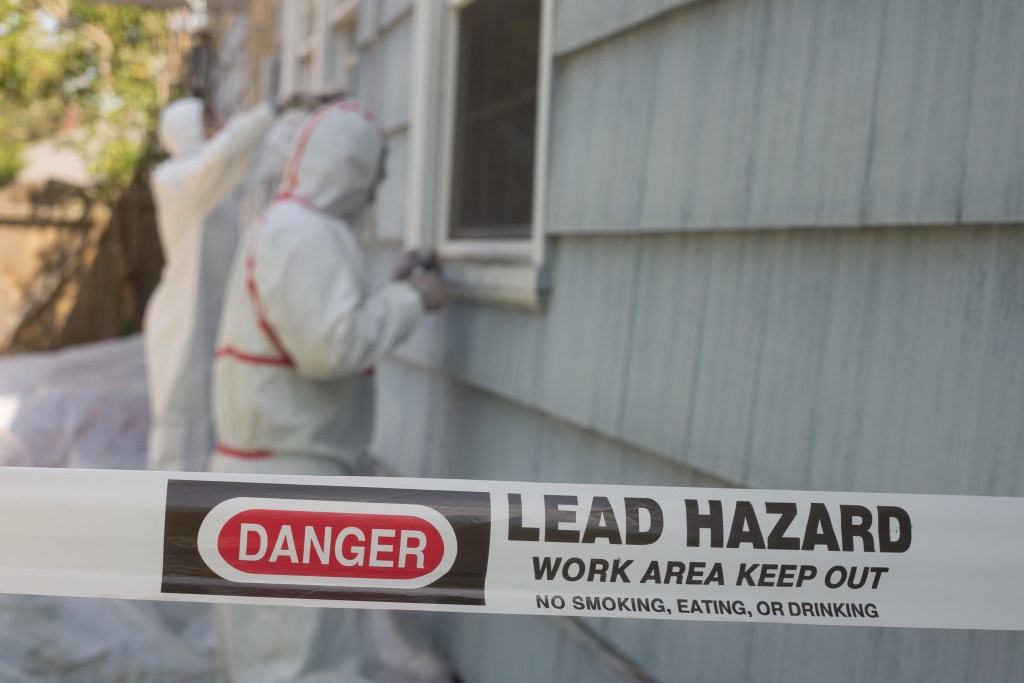
An old house can be coated with a kilogram or more of lead in the paint. Sanding an old house would leave more lead on the ground than you’d find almost anywhere else, so if we aren’t regulating its removal, I think it’s reasonable to say we are most certainly not managing the danger.
Lead paint removal HAS to be regulated, but until it is, you’re on your own, hoping the painters working on the old house up the street are doing it safely. Going by the number of painters with actionable blood lead levels, that is somewhat unlikely.
That brings us to what else you can do to reduce exposure to lead, at least if you’re willing to concede it might be dangerous.
Imagine a scenario where provided you detect and deal with any lead hotspots, you “could” safely ignore the harmful effects of lead because it wouldn’t be harming you, or your children. YOU, not the government agencies that look the other way when it comes to lead, or the mining company that is more interested in profit than people’s safety.
There is an industrial heavy metal complexing agent, called TMT that is used to remove heavy metals from flue gases and industrial wastes. It’s very probably used at the smelter.
TMT binds lead so tightly that it effectively passivates the lead so it is no longer biologically available. It makes lead safe for humans because they can’t absorb the lead from a TMT/lead complex.
When NQ cattle that were part of the live export trade, were tested for lead content some of them had unacceptable levels of lead. That created a problem for NQ cattle stations on lead-rich land because it threatened to kill their export market. The solution was to feed TMT to the cattle until all the lead was removed, and they were then deemed fit for consumption.
A more important use for TMT has been found in China where the mixing of industrial waste with sewerage meant that sewerage that was once used as an organic fertilizer was now unfit to be used because of heavy metal contamination. When TMT was mixed into the contaminated sewage the TMT completely passivated the heavy metals so that plants fertilised by the treated sewage were free of heavy metals, including lead.
TMT could provide an effective way to “decontaminate” lead-rich back yards in a way that would be far more elegant than covering a back yard with concrete and artificial turf.
IF the effort were made to identify dangerous concentrations of lead instead of ignoring the situation, they could be treated and rendered safe. I think that could be a pretty big deal for Mt isa because it could mean that Mt Isa could be safe for children. That’s of course dependent on the community dealing with the problems instead of ignoring them, but it’s possible.
The last part of the puzzle is what do we do about the lead that has already been absorbed by adults and children? That has to be considered because if body lead levels are high enough people WILL be harmed and this is especially true for young children. A lowered IQ, learning difficulties and behavioral problems may not be all that noticeable, but would youth violence caused by lead exposure get your attention?
If we could remove the accumulated lead and get rid of the potential for harm, wouldn’t that be worth doing?
Chelating agents, chemicals that bind and remove heavy metals, have been in use since the 1940s. Despite nearly 80 years of experience in removing lead, it’s still not commonly done, in the face of more than adequate evidence that lead can be safely removed from the body.
The story of why we’re not removing harmful lead is a sad one. Most clinicians don’t understand what chelation is about and confuse the various types of chelators and treatments. And then there are the urban myths about chelation being risky, causing kidney disease and even death. That was certainly true in the 1950s when too high a doses of chelating agent were applied for too long, but safe protocols were established 30 years ago.
As a result, our health authorities only use chelating agents when an individual has very high blood lead levels, or has clinical signs of lead poisoning. The point at which the use of chelating agent is considered is when blood lead levels are above 45ug/dl in children and 70ug/dl in adults. Chelation isn’t recommended or used for levels of blood lead below these values, despite the huge amount of data that shows values well under 45/70 ug/dl are most certainly harmful.
The NHMRC have a 2016 document titled “Managing Individual Exposure to Lead in Australia — A Guide for Health Practitioners” that states the following about blood lead levels between 20-44ug/dl:
- Patients may present with acute symptoms of lead exposure, such as gastrointestinal disturbances (e.g. nausea, vomiting, constipation and abdominal pain) and neurobehavioural effects (e.g. forgetfulness, irritability, headache and fatigue) in adults and behavioural changes
and reduced haemoglobin in children.
Note the comment about behavioural changes. Those changes include reduced cognitive ability, reduced decison-making ability and increased violence.
What the NHMRC guidelines failed to report is the increased risk of cancer, increased blood pressure and greatly increased risk of dying of cardiovascular disease as a result of blood lead levels between 20-44ug/dl.
The present situation is like only treating someone with cancer if they have stage 4 disease and ignoring it otherwise. How many more people would die of cancer if we took that approach?
Low dose oral chelating agents, are almost completely safe because the only possible risk is the depletion of essential trace metals, something you can avoid with the occasional mineral and multivitamin tablet.
We could safely remove lead from the body, prevent and reverse at least some of the neurological damage and safely avoid the ill-effects of lead exposure. But not while we’re ignoring the fact that lead is dangerous.
How many people do you think die because we do essentially nothing about lead exposure or removal? If the US CDC are correct in their estimates, and if we translate US figures to the same population ratio in Australia, somewhere between 35,000-40,000 Australians a year may die of diseases where lead was a contributing factor.
That’s twice the population of Mt Isa dying as a result of lead exposure every year. The NSW government estimates that 4000 Australians die every year of asbestos related disease, so we now take asbestos exposure seriously. But 10 times that number of people dying of lead-related causes doesn’t worry anyone?
Is it really safe to ignore the presence of lead?
Is doing nothing about dangerous levels of lead in the body the best possible solution?
If lead was safely removed from children and adults and if we add in the passivation of lead in contaminated back yards and playgrounds with TMT, Mt Isa could be safer for adults and children than any other city, despite the presence of lead, regardless of the source.
Safe removal of lead paint on older houses would have to be part of the solution, but older public housing represents an awful lot of government-owned houses so don’t expect much from the government there. I remember when the state government commissioned a survey of Legionella in buildings in the Brisbane CBD, prior to enacting legislation. Turns out most of the CBD building with Legionella were government-owned, so no legislation.
Mt Isa can’t afford to depend on government agencies to take any meaningful action on the behalf of the safety of the people of Mt Isa when it comes to lead and Glencore doesn’t care. You’re on your own.
The people of Mt Isa need to face the truth, face reality, and get busy protecting themselves. As a challenge: if people in New Souths Wales, in Broken Hill, can start to take control, surely Queenslanders can do the same.
 Lead in Australia - what you didn't know