I hope this blog might be read by someone outside Queensland, so I’d better explain that Queensland is on the northeast corner of Australia, with climate ranging from temperate to tropical depending on the time of year.
Most of the population of Queensland is near the coast or fairly close, whereas further inland you generally see smaller cities or towns that are dependent on local agriculture or mining.
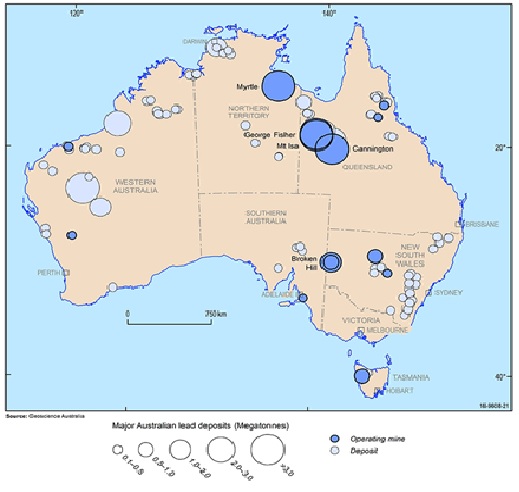
The map below shows the location of lead deposits or mines in Australia. You’ll notice that Queensland has quite a bit of lead. in the north west corner. The main lead mining and smelting city of Mount Isa, about 900 km from the coast. Mt Isa has been mining and smelting lead ore for over 90 years, and sends lead ingots and lead concentrate by train to Townsville on the coast. About 110,000 tonnes per annum of lead concentrate are shipped to Townsville, to be loaded at the Glencore Port operations. Lead concentrate was formerly shipped in uncovered wagons, leading to extensive lead contamination along the railway.
Historical contamination from lead concentrate loading operations into bulk carrier ships has led to most of the areas near the port being contaminated with lead concentrate, including children’s playgrounds. The air monitoring at the Coast Guard station opposite the port loading facilities shows lead concentrate dust peaks when bulk carrier ships are being loaded. The peaks exceed allowable limits, but our excuse for an EPA averages the total release per 24 hours, which effectively suggests there is nothing wrong.
Mt Isa is probably the only place in Queensland where the Queensland Health department makes any real effort to be appearing to deal with issues arising from lead exposure. That pretty much means that lead exposure is ignored in the rest of Queensland, including Townsville which is at least in part a “lead city”.
The focus on Mt Isa would be understandable from the viewpoint that Mount Isa has high concentrations of environmental lead, not only because the city is sited on the edge of a lead ore deposit and suffers lead dust from the mining, but there is also a contribution from the lead smelter which has one of the tallest smokestacks in the southern hemisphere, in the hopes the fumes will go far enough away to not be a problem to Mt Isa residents.
Queensland DPI carried out soil analysis near Mt Isa which indicated lead recent lead pollution many kilometers away from Mt Isa. They did this by measuuring the lead content of soil samples taken at different depths which quite clearly indicated much higher surface lead levels, most likely due to smelter emissions.
Mount Isa is an interesting place from the viewpoint that people have been ignoring lead for so long, presumably to protect the local economy, that it’s very hard to find anyone who has lived in Mount Isa for a few years who is willing to admit lead could be a problem. If you do start asking questions about lead, you quickly get unpopular with your neighbors.
The other lead cities (Broken Hill, mining, Port Pirie, smelting) are now quite active in trying to reduce lead exposure in children by continually monitoring blood lead levels in children as an indicator of the success of their efforts. While there are free walk-in blood lead testing,, there is NO official wide-scale testing of children for lead exposure aside from opportunistic testing for lead in left-over paediatric blood samples in the local hospital,. There hasn’t been a concerted effort to get a large sampling of childrens blood lead levels for over a decade.
There are Australia-wide programs run by Monash University and the Victorian EPA, where people can send in soil or dust samples for lead testing. Would it surprise you to learn that while Port Pirie and Broken Hill are well represented, Mount Isa isn’t? It appears not one member of the public in Mount Isa has sent in a dust or soil sample for toxic metal testing.
Up to this point I’ve concemtrated on the results of the mining and smelting operations, and the transport of lead concentrate.
However, there are much bigger lead problems in Queensland. The first is legacy lead contamination from leaded petrol along major roads and highways. That has resulted in the surface soil near the roadways being contaminated with lead, often well above allowable limits. There are many places where growing your own vegetables can be a health hazard because of lead.
A much more widespread problem is lead paint on older (pre-1970) houses which number in the tens of thousands (possibly as many as half a million) all over Queensland. Regardless of whether the houses have been maintained or not, you either have direct exposure to lead paint, which is very attractive to children because of the very sweet-tasting lead acetate added as a hardener, or if the houses have been repainted, particularly after flooding, the areas around the houses will be heavily contaminated with lead paint dust or chips.
Queensland has had a long history of dealing with lead poisoning from lead paint. Queensland physicians published many of the early scientific and clinical papers about child lead poisoning from lead paint.
And then things started to go a bit off course. Maybe it was the influence of the Lead cartel active in the 1930s, or the proponents of leaded petrol or lobbying by mining interests, but whatever the reason, the public awareness of the dangers of lead paint started waning. Something went terribly wrong at the beginning of this century, when there appears to almost have been a concerted effort to minimise information about the dangers of lead paint or perhaps lead as a whole.
Queensland Health are obviously aware of the dangers of lead, as for example in one of their public statements:
This analysis indicates that the public health focus for elevated blood lead levels should be to make the general public aware of the dangers of lead exposure whilst renovating old homes and the precautions they should take in this circumstance. In particular, measures should be adopted to prevent children from ingesting paint or other lead-based materials whilst renovation is occurring.
And yet, after the 2011 floods in Brisbane and Ipswich, where many older homes were flooded, there were public warnings from the Health Department about asbestos and contaminated water, but no mention of lead.
When questioned, their response was:
Queensland Health’s post-flood focus was on the issue of asbestos debris and contaminated water problems as these were the issues of key public health concern. Information for the public in relation to dealing with lead in paint during home renovation and restoration work was already available and accessible to renovators and contractors.
Just because they didn’t mention the hazards resulting from lead paint doesn’t mean they didn’t have information available, if you knew where to look, if you had an inkling that removing lead paint was dangerous. I
If people were concerned about lead exposure, they had to ask their doctor for a blood lead test, or demand a blood lead test from their pediatrician for their children. Surely if lead was identified as a danger, that should have involved some sort of public health directive to screen for lead poisoning?
From Queensland Health’s own data (2016), painters are one of the largest group of individuals with actionable blood lead levels. If painters are affected, what about the occupants and children living in the houses that were renovated? Why weren’t those children and adults tested for excess lead exposure?
But there is worse to come. Despite the fact that Queensland Health have a publicly stated intervention protocol, that protocol is most often only applied to children in Mt Isa. It appears while Queensland Health is anxious to appear to be doing “something” in Mt Isa, they are largely ignoring their responsibilities in the rest of Queensland. If an infant with a blood lead level of 22ug/dl due to house renovation fails to receive any intervention, then it could be reasonable to speculate that there is a lack of priority in dealing with lead exposure.
I’ve already pointed out that Queensland Health are no longer releasing updates on the number of actionable lead event in Queensland since 2016, or that they deal with questions from the public about lead by restricting communication and then blocking it.
What went wrong?
Are they so ashamed of their failures that keeping quiet about lead is the only way to avoid the public repercussions?
I would recommend downloading and reading a document released because of a FOI request from ABC News, DOH-DL 17/18-048 (2017/18 Disclosure Log (health.qld.gov.au)). It gives a useful insight into how Queensland Health spins it’s efforts so it appears to be doing it’s job. Quotes in the document also emphasize the importance of dealing with the issues of public housing painted with lead paint in Mt Isa.
It’s probably also worth mentioning the role of media advisers in what I see as a disgraceful debacle.
My frustration with getting any useful information out of Queensland Health finally caused me to lodge a complaint with the Queensland Health Onmudsman. The complaint had two parts, apparent lack of action in effectively dealing with paediatric lead exposure in Queensland and Queensland Health’s quite obvious unwillingmess to engage to address the child health issues.
I got a reply which was unexpected, because I thought the latter issue was due to an “unofficial” Queensland Health policy. I was wrong, because the reply I got from the Health Ombudsman was:
‘The concerns raised relate to a government policy and do not relate to a health service provided to you or to a health service provider, and as such it does not constitute a health service complaint within the meaning of sections 7 and 31 of the Health Ombudsman Act 2013.’
As I said, this answer was unexpected because it possibly suggests that non-communication about lead-related issues is an official government policy.
So here we are.
We have laws about asbestos, or silicosis from manufactured stone, but next to nothing about lead. There are plenty of watered down warnings, but no public recognition that lead is dangerous. If an individual was sufficiently concerned to try and access the Australian standard for the safe removal of lead paint, they would find the standard is behind a paywall, and costs $165 to download.
How could this have happened? How can “responsible” adults ignore a scenario that is possibly harming many children in Queensland without doing anything?
There are many reasons, not the least being lobbying by lead-industry interests, and in the past, when we lacked the means to treat the results of lead exposure ignoring the problem at least had an economic justification, because the only solution to the problem was shutting down the lead industry. But we now have the means to non-invasively detect lead exposure, and to be able to reduce or reverse some of the effects of lead exposure in children. But we still do nothing.
This is beyond shameful.
 Lead in Australia - what you didn't know