Special Note: This is still a work in progress. I will correct things as I spot them. U.M.
I’ve talked about lead poisoning from renovating houses quite a few times in the last couple of years. But it’s time I was a bit more specific. It’s appropriate for another reason, since it’s almost a century since the last time painters in Queensland were properly informed about the dangers of lead paint.
Let’s start at the beginning of the understanding about the dangers of lead paint. It begins in Brisbane, Queensland.
There had been a large number of children with kidney and neurological disease in the Brisbane Hospital for Sick Children. The cause was found to be lead poisoning due to the licking or eating of lead paint.
As a result, Dr Leslie Jon Jarvis Nye, a physician in Brisbane, published his 1933 paper in the Australian Medical Journal, “Chronic Nephritis and Lead Poisoning”. This so concerned the Lead Industry Cartel that they even commissioned a “scientific” monograph to refute it. Lead paint was making a lot of money so anything that might discourage its use was denied.
Children were getting lead poisoned from lead paint because it tasted like candy. While the main components of lead paint have an unpleasant metallic taste, lead acetate is added as a hardener, and it is as sweet as sugar.
This wasn’t the first time doctors had tried to stop the use of lead paint, but despite the fact that anti-lead paint legislation had been enacted years 11 years pearlier (1922), that ban had been ignored as often happens with legislation that isn’t enforced. With support from the Premier, Forgan-Smith, and the Communist secretary of the Painters’ Union, Dr Nye was invited to explain about the dangers associated with lead paint to a meeting of Brisbane painters and from then on, they refused to use it for their work
I brought up the term the lead cartel, and despite the fact that lobby groups weren’t officially recognized they were obviously effective because lead paint continued to be used.
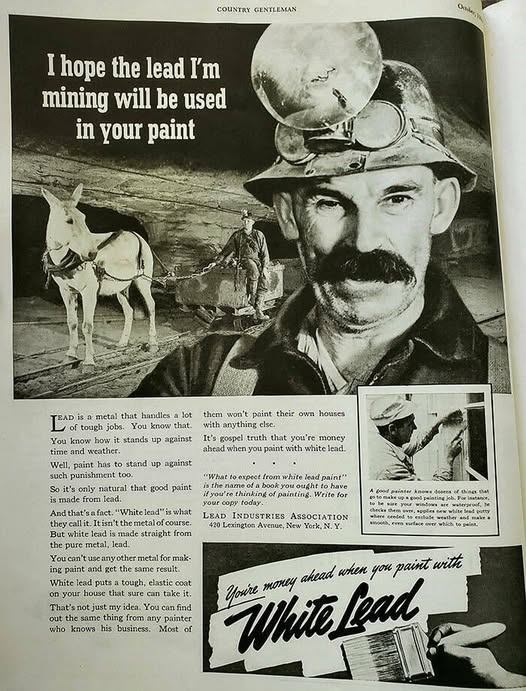
The “final” enactment prohibiting the use of lead paint did not become law until 1956. It was as ineffective as previous legislation and it wasn’t until the Australian Uniform Paint Standard was amended in 1970 that the lead content of domestic paint was reduced to a maximum of 1%. I need to stress that this applied only to domestic paint quantities, like buying 4 litre can of paint at the hardware store. If you bought lead paint in large quantities, commercial quantities, there were no restrictions. That loophole meant large building projects such as those for social housing estates in the 1970s were still painted with paint containing dangerous levels of lead.
The implications of this bit of history are simple. If a house was built before 1970, you can be certain that it was painted with lead paint. Defense and Housing commission houses may have been painted with lead paint as late as the early 1980s. Even if an older house had already been renovated, it will have lead paint dust in the ceiling spaces, under the house and heavily contaminated areas around the house. Unless all the old paint was removed, further sanding and paint removal will likely still produce yet more dangerous dust.
I’ll discuss some of the things that lead paint dust can do to you a bit later, but a story worth reading if you want to find out more about the effects of lead paint dust on young children is “Autism, ADD, or Lead Poisoning?: Turning Lead into Gold” by Nancy Hallaway. It’s a Kindle book (cost is $8) and it tells a harrowing story about Nancy’s twin boys who were affected by lead paint dust when Nancy and her doctor husband renovated their newly purchased old house. It has a happy ending, of sorts.
It would be reasonable to ask what is being done these days to avoid lead poisoning from lead paint. In Queensland and the rest of Australia, the answer is not much.
Queensland (and Australia) is way behind the rest of the developed world in combatting the danger of lead paint, but most of my examples will be with what happens in the United States.
In the US, lead paint removal is treated with the same care as that taken with asbestos in Australia. There are regulations defining safe removal procedures, tenants or buyers of older houses must be advised of the presence of lead paint in their apartment or house, programs exist for the replacement of wooden windows painted with lead paint and so on. In a nutshell, the dangers of lead paint are recognized and social programs are in place to try and deal with this hazard.
That’s most certainly not the case in Australia. While there is some activity to reduce lead exposure from mining and smelting activities in Mount Isa, Broken Hill and Port Pirie, lead poisoning from whatever source is largely off the radar elsewhere. In fairness to Australian regulators, there is an Australian Standard for the safe removal of lead paint from older buildings, As/NZS 4361.2:2017 (Hazardous Paint Management – Part 2: Residential, Public & Commercial Buildings). However, that standard is not freely accessible because it is behind a paywall and the last time I looked at the cost it was $165. It is also individually branded to discourage its distribution (it’s copyrighted) to other people, for example fellow painters.
I think this is pretty obscene, but it does illustrate that Australia isn’t serious about dealing with the health issues arising from exposure to lead paint, or indeed any other form of lead.
Unlike asbestos, there is no regulatory requirement for the safe removal of lead paint. As an example, WorkSafe Queensland provides quite a bit of useful advice (https://www.worksafe.qld.gov.au/safety-and-prevention/hazards/hazardous-exposures/lead/working-with-lead-based-paint), but no real enforcement. The best information freely available is from the Painters Institute (https://painters.edu.au/Business-Development/Workplace-Health-and-Safety.htm). Testing for lead paint is relatively easy and inexpensive, but if you haven’t tested for the presence of lead paint, you’re on your own.
There are specialist painting companies that are equipped to deal with the dangers of lead paint, but their cost discourages any but seriously concerned owners of older houses. Then again, the eventual costs related to you and you family getting lead poisoned are significant as well.
I was talking to the owner of a nearby paint shop and he told me about one of his customers, a painter who had been advised to get another kind of job because his blood lead levels and symptoms were getting to the not so good stage. No treatment was suggested by his doctor. That’s a tragedy on several points because relieving the symptoms of lead poisoning and reducing the amount of lead in your body is both safe and inexpensive. There is no reason a lead-poisoned painter couldn’t go back to work, if he wanted to.
An event that ended up affecting a lot of painters was the 2011 flooding in Ipswich and Brisbane. Quite a few older houses had been flooded, and as they dried out and the paint started to split and bubble it prompted a huge effort to renovate the homes. It also provided a lesson about exposure to lead paint.
I’d recommend listening to this ABC News podcast about lead poisoning in painters and DIY renovators following the floods in Ipswich and Brisbane ((https://www.abc.net.au/listen/programs/backgroundbriefing/4408246).
It would have been appropriate to have some sort of warning from the Health Department, and while there was a warning about asbestos and contaminated water, there was no mention of lead paint.
When questioned, their response was:
Queensland Health’s post-flood focus was on the issue of asbestos debris and contaminated water problems as these were the issues of key public health concern. Information for the public in relation to dealing with lead in paint during home renovation and restoration work was already available and accessible to renovators and contractors.
If you were aware of the dangers of lead paint AND you were looking for information on how to deal with it safely, you will of course have checked Queensland Health’s web site. Really? Judging by the comments from people interviewed in the ABC podcast, Queensland Health dropped the ball pretty badly. As mentioned earlier Queensland medical system was well aware of the dangers of lead paint 70 years ago. What happened?
I have made numerous attempts to engage with Queensland Health on lead issues over the last 2 years and have largely failed, with two exceptions, a toxicologist in Townsville whose knowledge of clinical aspects of lead was 40 years out of data and a senior physician in Townsville who was cautiously interested. I had gotten his contact details from a Queensland Health FOI document requested by ABC News, a Queensland Health FOI document, requested by ABC News, DOH-DL 17/18-048:/ He had stated:
“As things stand, I do not believe that government owned houses, with highly contaminated soils and exposed Lead paint, are safe places for children in Mount Isa”.
I need to stress what this might mean because this related to social housing in Mount Isa where lead paint on the houses was considered a greater danger to children than the lead from mining activities. Think about that in the context that Mount Isa is heavily polluted with lead-containing dust already, not just from the natural lead ore deposits and mining activities, but from smelting as well. Nevertheless, that comment indicates at least one person in Queensland Health was actively aware of the dangers of lead, as opposed to it being ahistorical issue. It’s a pity that the bureaucracy is more interested in covering up any news of lead exposure.
I’ve learned about the opportunistic blood lead testing of children in the Mount Isa Hospital which provides some idea of the extent of blood lead levels in Mount Isa children, since the last real survey was back in 2011. But as far as I have been able to discover, the results of that opportunistic testing have not been made public by Queensland Health. What are they hiding?
I was also informed about the acquisition of a portable XRF spectrometer so Health staff in Mount Isa could check the areas around homes for high levels of lead contamination in the event of notifiable blood lead levels in children living there. To the best of my knowledge, I have no indication that XRF has been used as yet.
If I were cynical, which I didn’t use to be, I’d be saying that Queensland Health have been withholding information that might indicate how bad a job they were doing. Then again, Queensland Health also works closely with Glencore, the company running the mine s and smelter in Mount Isa, as it is a member of the Lead Alliance, together with Robbie Katter, a representation from Glencore and people from local healthcare institutions. My interaction with the Lead Alliance suggests their main goal is to manage public opinions about the effects of lead in Mount Isa.
I wish it was otherwise.
I have to apologise for straying off topic, but I hope this has provided some indication that if the painters or the public are expecting some affirmative action from Queensland Health about lead poisoning in general, it’ll be a long wait.
If we get back to painters, please be aware that unless inordinate care was taken during sanding and paint removal, including dust masks and PPE, it’s likely that a painter working on an older (pre-1970s) house will have been exposed to lead paint dust, will have raised blood lead levels, and more importantly, will likely have taken some of that lead dust home.
In Mount Isa, lead miners have to shower and change from work clothes which stay on site and are specially cleaned, to street clothes so their families aren’t exposed to lead dust. Lead paint dust is no different, except it sometimes has higher lead content (up to 50%).
Lead is particularly dangerous for young children because it can inhibit their brain development and have serious effects on their learning ability and behaviour. If you’ve read Nancy Hallaway’s book, you’ll understand what can happen.
Lead accumulates in the body and much of the lead that has been absorbed will remain in the body, in the bones. In adults, this means the lead will remain for decades, maybe the rest of their lives.
Every time a painter (or his family) is exposed to lead dust, a bit more lead will accumulate in his body. It’s really important to get your head around the fact that even small exposures over a period of time will add up, as will the harmful effects. There is no safe level of lead that you can afford to ignore.
I’d like to reinforce my comments by indicating the extent painters are lead-poisoned. Queensland Health used to publish an official report of the number of notifiable blood lead levels over 5ug/dL every year in Queensland. The last time this was done was 2016 and no results have been published since. The numbers are split into groups and in 2016 painters comprised the largest single group of notifiable results.
These are painters that have been tested that have a significantly raised blood lead level. A painter, if suffering lead poisoning symptoms, has to have gone to a doctor, and the doctor has had to recognize the symptoms of lead poisoning and order a blood lead test. That often doesn’t happen so no test, no result, no notification. The rate of blood lead testing in Australia (Medicare 2016), excluding lead risk workers who get tested regularly, is less than 1 in 2000.
If you’ve been working on older houses, you will be lead-poisoned to a lesser or greater degree. The best way to ensure you get a blood lead test is to ask for one and say you’ve been renovating a house painted with lead paint. (Medicare don’t like paying for blood lead tests without a good reason).
If that test comes back with a blood lead level over 5ug/dL (micrograms per decilitre), the testing laboratory has to notify Queensland Health, which “ought” to initiate some sort of audit and advice process. I say ought because it appears that Queensland Health fails to follow its own intervention policies in most cases, notifications for children in Mount Isa being the possible exception.
So why should you care if your blood lead level is raised?
I’ll start with an excerpt from a clinical article from the UK, “Lead poisoning: case studies” that was published in 2002. It has a good description of the symptoms in a painter:
A self-employed decorator aged 51 years presented to his general practitioner with a 4 week history of nausea, constipation, headaches, intermittent dizziness, and paraesthesiae (tingling burning sensation) and weakness of the hands. He said that he had experienced prolonged exposure to lead paint whilst redecorating a late regency house (circa 1820) in Bath. His initial blood lead was 4.04 mmol l x1 (84.2 mg 100 ml x1). No abnormalities were detected on physical examination.
The quotes value of 83.4 mg (milligram) must be a mistake because this person would be dead. If we change the value to micrograms (ug) it’s still very high. Someone with a blood lead level of 84.3 mg/dL is considered to be severely lead poisoned and warrants IV treatment to reduce body lead levels to get rid of the more severe symptoms, which is what happened for this painter.
The effects of lead poisoning get a lot worse as blood lead levels rise.
I’ve enclosed a useful chart:
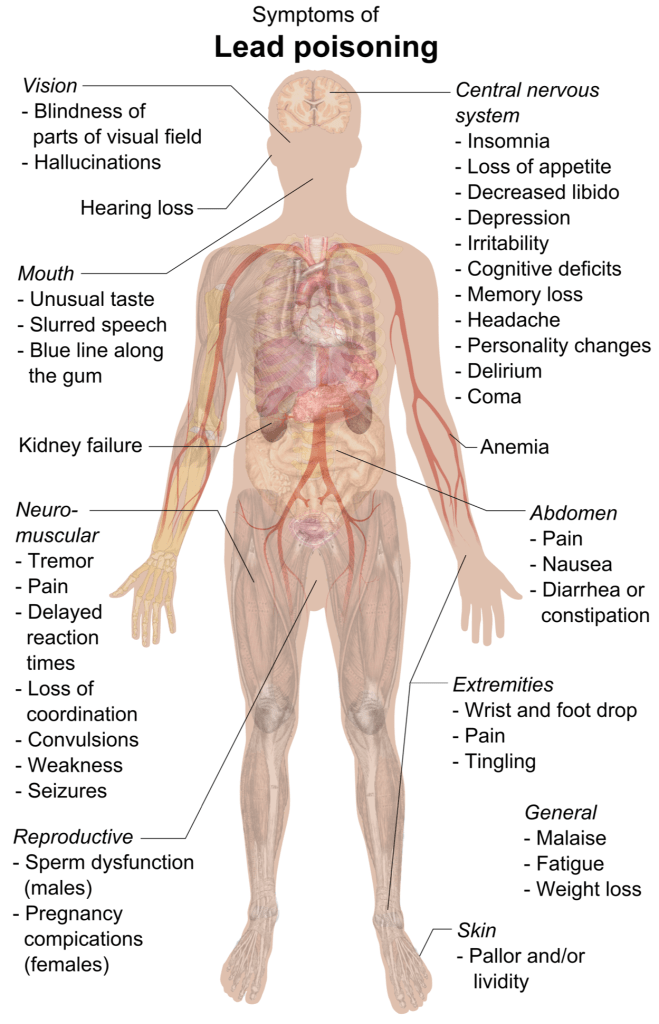
That’s just an example of the sort of symptoms that you can have. Remember your GP may not recognise the symptoms of lead poisoning. If you’ve been working on old houses, ask for a blood lead test.
Officially anything over 75ug/dL (45ug/dL in children) is considered to be serious and is treated with chelation therapy, most often intravenous infusion of calcium disodium EDTA (ethylene diamine tetraacetic acid). Lower blood lead values are often untreated. The general medical opinion is the effects of lead poisoning are irreversible, so treatment except to alleviate severe symptoms is pointless.
This is despite the fact that there is a LOT of evidence that if you have blood lead levels much over 20 ug/dL, you are facing a barrage of deleterious effects:
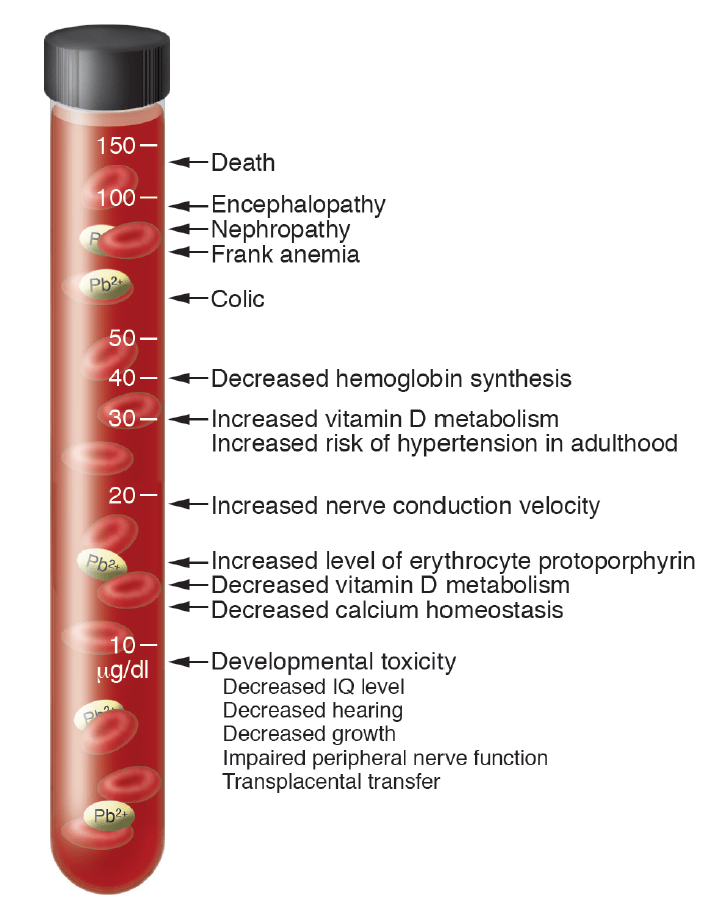
I’m going to repeat myself and say that while any BLL over 75 ug/dL ought to be treated, values much below that most often aren’t. Consider what happens between 7-75 ug/dL on the above chart.
There is also a mistaken perception that lead rapidly leaves the body. It absolutely doesn’t. We continue to accumulate more and more lead in our bones as we age and are exposed to lead. Even if you stop working as a painter the lead in your bones takes many decades to leave your body and as the amount of lead in our bones and bodies increases, so do the ill effects of lead.
Clinical studies have consistently demonstrated that lead exposure is associated with a negative impact on a range of health issues involving the heart, kidneys and brain. A number of large-scale epidemiological studies have indicated a strong link between elevated blood lead levels in adults and premature death from cardiovascular disease. A longitudinal study compared cognitive test results of men with both high bone lead levels and no bone lead levels. Men with higher levels of lead in their bones showed cognitive declines comparable to aging an extra five years.
In addition, researchers found that adults age 44 and older with only slightly raised blood lead levels (6.7 µg/dL as compared to the current actionable “limit” of >5ug/dL) had a 37 percent greater risk of death from any cause and 70 percent greater risk of death from cardiovascular disease than those without similarly elevated blood levels. Cardiovascular disease contributed to by lead exposure includes peripheral vascular disease and atherosclerosis.
I could provide a lot more detail, but it should be enough to say that getting lead poisoned and accumulating a lot of lead in your body is a really bad thing. Not removing the lead is a bit like not treating a cancer, as bad things could happen.
If you’re interested in more detail, read my previous blog posts. I need to concentrate on leaving you with an important message besides not depending on the Health Department for effective action.
Can lead poisoning be treated so you can get back to earning your trade as a painter?
Absolutely yes. As I’ve said, left untreated, the lead you’ve absorbed from lead paint will stay in your body for decades. The neurological effects in particular (Psychosis, insomnia, anger management problems), kick in at relatively low blood lead levels and can be largely reversed IF the lead is removed. Lead poisoning is largely reversible, many of the symptoms of lead poisoning are reversible.
The most effective way to remove lead from the body is with drugs/chemicals called chelation agents (chelators). When I mention chelation, that refers to the use of chelating agents. There are lot of different chelators but the really effective ones are all synthesized or manufactured. The ones that are broken down in the body (metabolised) often produce undesirable side effects in some people
I need to differentiate between intravenous chelation, which is carried out if the blood level is over 75ug/dL as an emergency treatment and needs to be administered under medical supervision, and oral chealtion for lower blood lead levels that generally don’t get treated, except by a very small number of doctors that know about lead and chelation. Oral chelation is something you can do yourself, whether your doctor is informed enough about lead poisoning or not. It’s very much about self-help because if you mention chelation to a doctor, you will often be told it is dangerous, can cause kidney and liver disease and even death. That’s bullshit.
Oral chelation can be both safe and inexpensive. A number of chelating agents are used for oral chelation but only one is easily available, has minimal side effects and is inexpensive. It’s a common registered food preservative, calcium disodium EDTA (CaEDTA) and provides a safe and effective way to remove lead and other heavy metals. If you have CaEDTA with food, either in a capsule or even baked into biscuits, it will not only remove lead from your body but also provide protection from lead exposure because it results in a net decrease in the amount of lead in your body.
Calcium disodium EDTA (CaEDTA) is a registered food additive (# E358, Australia and New Zealand Food Standards) and the maximum recommended food additive dose has a huge safety margin for administration. EDTA is not metabolised in the body and it has minimal, if any, side effects. You can buy CaEDTA from iHerb for about $80 for a years supply of capsules.
I’d like to repeating a few things I think are important.
- If you’re renovating an old house make sure you test for the presence of lead paint in the areas you’re renovating, White-painted wooden windows are a classic place for lead paint. Get a test kit from Bunnings, many paint suppliers or order it from the Lead Group (The LEAD Group Shop –)
- Always wear a dust mask, regardless of whether you’re the one doing paint removal or not. Think about wearing disposable coveralls so you don’t take lead-dust contaminated working clothes home.
- If you work on a lot of old houses, get regular blood lead tests if for no other reason than your own peace of mind. Even if Medicare doesn’t cover the cost of the test because you’ve had too many in one year, it costs $38 and is worth it.
- If you have a blood lead level over 5ug/dL, you need to think about doing something about reducing the amount of lead in your body because unless you’re very lucky, your doctor won’t consider treatment as an option.
- Either read my other blog posts or email me to get more information on calcium EDTA to both prevent lead accumulation and remove lead from your body. The American CDC stated that there is no safe level of lead in the body. Take that seriously.
- I didn’t discuss this earlier (sorry), but there is a way to decontaminate lead-contaminated soils with a relatively cheap spray that will also act as a plant growth promoter. It passivates the lead in the soil so it is biologically unavailable. The product is called RC3 and is available from Green Earth Technology (https://greenearthtechnology.com.au/products-services/) in Queensland. I have no financial connection with this supplier.
If you come across a lead-paint contaminated yard and the owner has chickens, RC3 will ensure lead-free eggs.
 Lead in Australia - what you didn't know