Think of blood lead as being lead in the red blood cells from recent exposure, plus lead from your tissues (bones) that has accumulated over time. As the combined blood lead level goes up, so do the effects of lead and the figure below gives a reasonable idea of what might happen as blood lead levels increase.
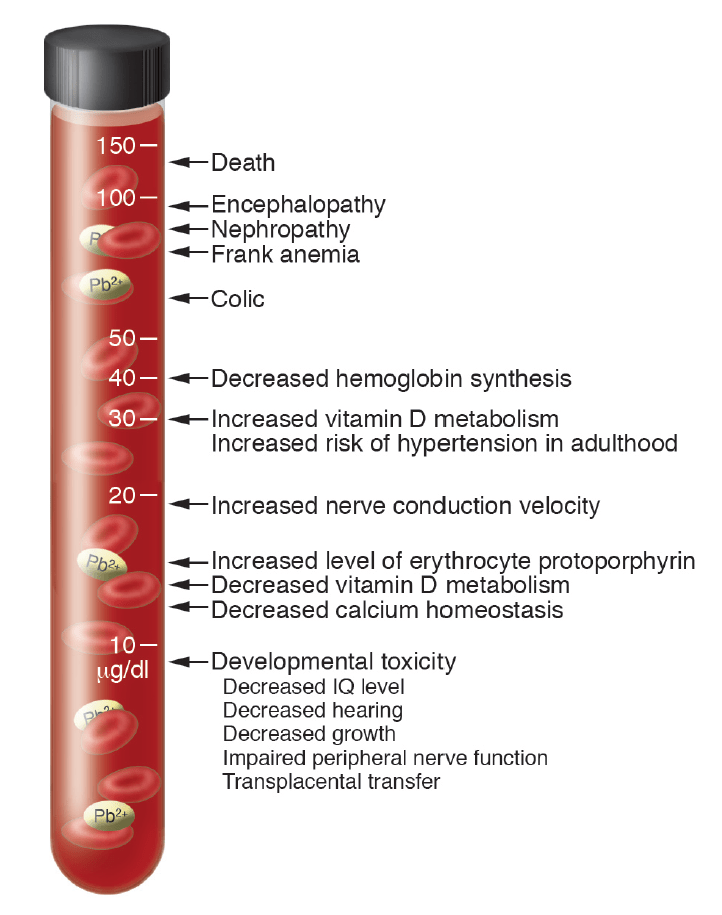
What this figure doesn’t show very well is that neurological effects are some of the earliest indicators of increased body (and blood) lead levels.
We know about decreased IQ due to reduced nerve interconnections that ultimately result in reduced cognitive ability and intelligence. Decreased hearing actually refers to decreased speech-comprehension ability, because kids hear what you’re saying, but they have trouble understanding.
In a lot of ways it is the behavioural changes caused by lead exposure that are equally important.
The main purpose of showing you this figure is to make the point that blood lead levels below 45 ug/dL in a child aren’t something you can ignore because they most certainly indicate the possibility of harm and should be treated accordingly.
Unfortunately, many doctors, especially paediatricians, think that once a child no longer has life-threatening blood lead levels, there’s nothing else to be done because the effects of lead are irreversible and chelation is dangerous. I should add that’s if they realise lead exposure is dangerous at all.
If they remembered any of the biochemistry they were taught when studying for their degree, and knew anything about the actions of lead in the body they would realise that they were bloody ignorant (Sorry, I’m Australian).
Lead competes with and displaces calcium, so it inhibits calcium channel operation and neurotransmitter release in the brain. Think of it as a communications blackout.
Lead binds to sulphur-containing enzymes and displaces zinc from zinc enzymes, in both cases inhibiting important enzyme systems that are involved in things like haemoglobin synthesis, vitamin D metabolism and so on. If the lead is removed, these systems recover and resume normal function.
What only a few physicians realise is that there are animal experiments with lead that indicate very low concentrations of lead have significant neurological effects. Of all the organs, the brain is most affected by even low levels of lead. You might find this interesting: https://publichealth.jhu.edu/2007/guilarte-neuroscience Thomas Guilarte’s group have also found that even the developmental effects of lead are reversible.
If you’ve been following this blog you’d know I started my lead journey in the occupational health and safety space and I have had contact with workers who were severely lead poisoned in their jobs. The chelation treatment they received was sometimes decades after they were poisoned, but most of the neurological effects disappeared as lead was removed.
I know that damage from lead is reversible. Not quickly, but it is possible provided the lead is removed. Doing nothing is throwing away your child’s future.
 Lead in Australia - what you didn't know