Sorry, I couldn’t resist. While the words are accurate, this headline is just something I’ve made up.
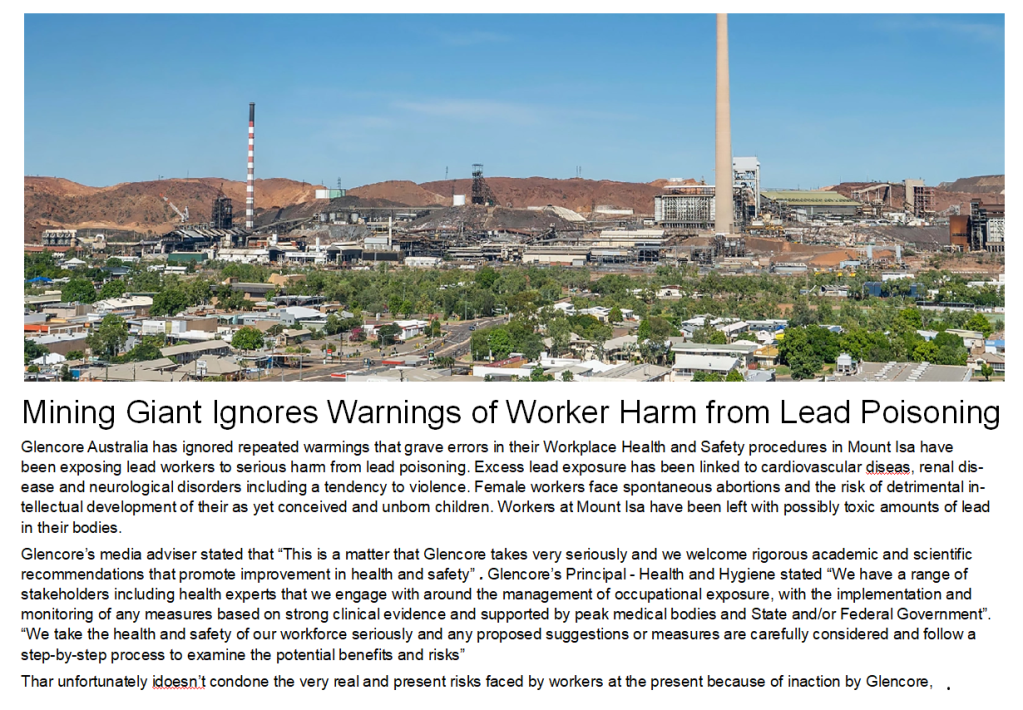
The fact that lead workers in Mt Isa are at increasing risk because Glencore are happy to hide behind their regulations, should matter, but it doesn’t.
Sure, you could be safe from the toxic effects of lead, but you’re special and much less likely to be harmed by high body lead levels that the general population.
So I’ll post a bit out of Safe Work Austrlias “REVIEW OF HAZARDS AND HEALTH EFFECTS OF INORGANIC LEAD – IMPLICATIONS FOR
WHS REGULATORY POLICY” It’s actually pretty well written, and nearly up to date.
In the introduction, we have:
The health effects of lead are directly related to the concentration of lead in the affected organ systems. This in turn is directly proportional to whole blood concentrations. Blood lead (PbB) concentrations have been the traditional measurement of internal exposures to lead and indicators for management actions for persons overexposed to lead in the workplace.
Almost right. Your PbB (BLL) will reflect the amount of lead in your organs and bones in the absence of acute lead exposure. Since you’re working in a lead risk environment, constantly exposed to lead, PbB doesn’t tell you anything useful except you’ve been exposed to lead. It doesn’t tell you the lead has moved to your brain and bones. PbB indicates exposure to lead. In the absence of lead exposure, it is a relative indicator or body lead burden.
A raised PbB doesn’t tell you how much lead has entered your body, and a falling PbB most certainly doesn’t indicate that a lot of lead has left your body.
I’ve been pushing Glencore to look at XRF, and it has a mention in the SWA document (page 5).
Of these the procedure with the most promise for supplementing PbB information is measurement of bone lead by non-invasive X-Ray Fluorescence (XRF) techniques. It provides a good, perhaps better indication, of chronic past exposures and total body burden. Unfortunately since bone lead reflects chronic exposures it arguably may not be an ideal method in the workplace to identify ‘at risk’ persons (i.e. persons currently assimilating unacceptable levels of Pb from workplace exposures). Whether the technique has been adequately developed and validated as a routine monitoring tool is also arguable.
This document is at least 4 years old. Thanks to a bunch of publications by Nie et all at Purdue University, XRF is a solid way to measure body lead levels.
The mention of chronic past exposure is spot on. If you’ve worked somewhere else and start work at Mt isa, you might already have quite a bit of lead on board. Then again, the body lead burden measured might be what you’ve picked up in the last few months. Wouldn’t you like to know the risk posed by accumulated lead in your body? Or if you’re female and thinking of having a family and you’ve been exposed to lead?
This is really critical for a pregnant or breast-feeding mother because at least some of the lead accumulated in your body will be passed on to your child. That’s regardless of whether you have a “low” PbB or not. Lead you’ve accumulated in your bones sticks around, until it’s needed to “nourish” your child.
Here’s a brilliant comment also on page 5:
We consider the information on worker cohorts to be more germane for informing decisions regarding standards for workplace exposure than the general public information.
This is saying that because lead workers typically have higher PbB, it’s okay to use higher acceptable PbB that the general population. It’s official, you people are super people, unaffected by al sorts of things. Or are you?
If soldiers are adversely affected by lead, and I don’t mean being shot, why not you? What is special about you that means lead doesn’t affect you. What is special about you that means you don’t have to worry about carrying around a toxic legacy. In an ideal world, having a job shouldn’t cost you your future health.
If you found you’d been exposed to a lot of asbestos dust and might get mesothelioma, would that be okay?
(page 6)
Most health endpoints (effects on the nervous system, increased blood pressure, heart rate variability, kidney dysfunction, changes in immune system markers, reduced sperm quality, haematological effects) for which there is sufficient information for them to be reasonably linked with lead exposure at work have been associated with occupational cohort mean PbB levels of >20 μg/dL.
There you have it, unlike the general population, you’re safe except when PbB goes above 20ug/dl. Lucky you. Except there’s a hell of a lot of evidence that says 20 ug/dl is too high, and 30ug/dl is even worse.
The majority of studies report health effect associations starting at worker population mean PbB levels of 25 – 30 μg/dL. At mean PbB concentrations >30 μg/dL the associations become more robust and reliable. Hence in the workplace, for females not of reproductive capacity and for males it is suggested a BLRL of 20 – 30 μg/dL is appropriate.
Of this range, 20 μg/dL is a pragmatic No Observed Adverse Effect Level (NOAEL) and can be rationally argued as an appropriate precautionary BLRL for the protection of nearly all workers, particularly since it relates to a central rather than a lower bound estimate for populations of lead exposed workers.
A PbB of 5-10 ug/dl in the general population is associated with known deleterious affects like cardiovascular disease. But 20ug/dl is a No Observed Adverse Effect Level in lead workers? What does pragmatic mean in this context? My head hurts.
A recent study was published by the Monash Centre for Occupational and Environmental Health of workers currently in ‘scheduled’ lead related jobs (i.e. lead exposed jobs). Of workers for whom PbB results were available, approximately 30% have had at least one PbB measurement greater than 30 μg/dL.
There’s a bit more in the report findings to date (it’s a multi-year study) that SWA didn’t report:
The first round of registry linkages found that 406 cohort members had died, which was statistically more than expected compared with the general population. In particular, deaths by non-cancer digestive system diseases and by external causes, such as injuries and accidents, were elevated compared to the general population.
And:
A total of 228 subjects had cancer, with an overall SIR of 83 (95% CI, 73–95); liver cancer SIR of 217 (95% CI, 103–454) and esophageal cancer SIR of 240 (95% CI, 129–447). The latter was seven-fold greater (SIR 755; 95% CI, 314–1813) among those with a blood lead level result above 30 μg/dL compared with population rates.
A seven-fold greater rate of oesophageal cancer in men with a PbB over 30ug/dl. And that doesn’t justify better protection in terms of monitoring and maybe lead removal? Then again, if the safe level were dropped to 10 ug/dl there would be no lead workers able to work after 3-6 months of exposure.
I wonder if they did autopsies on the dead lead workers to look at body lead burden? Then again they wouldn’t have to wait for you to die if they were using XRF to estimate body lead.
We have a national “authority” that is both talking about the dangers of lead, and then ignoring them when it comes to lead risk workers. Kind of insane maybe. Did you know one of the neurological effects of lead is to reduce your ability to think and disrupts your decision-making abilities?
They better pay you a lot more because you’re going to need it..
I found an article published in 1962, over 60 years ago, in the British Journal of Industrial Medicine. The article starts with this statement:
“Despite the advances in the design of factories working with lead and the installation of protective devices, lead intoxication is still prevalent. Treatment of this condition has been considerably improved by the use of the calcium disodium salt of ethylene diamine tetra-acetic acid (E.D.T.A.) (Bessman, Ried, and Rubin, 1952).“
It presents a case study where 8 lead-affected men were given a 7-day course of 4 grams of calcium disodium EDTA daily while still at work. On average they excreted 20mg of lead in that period and there was a significant improvement in laboratory findings after treatment.
The authors go on to say that oral EDTA should not be used as an excuse to avoid reducing lead exposure, and its use should therefore be limited. However, they end the article with the following statement (Versenate is the Dow Chemicals trade name for EDTA):
“Oral versenate appears to be a useful supplementary measure in the medical supervision of people who run the risk of absorbing lead.“
You don’t have to leave Mt Isa with a deadly legacy that WILL cause health issues in the future. I’ll repeat what I’ve said before, I’m not trying to shut down Glencore’s operations, or kill your jobs, or damage the economy of Mt Isa, but wouldn’t it be a good thing if a biohazard like lead was treated with the same respect as an industrial accident?
I’ll remind readers again that lead risk work could be safe, if it was properly monitored and IF excess lead was removed if you absorbed it. You don’t need to go to other jobs, you don’t need to leave Mt Isa, all it needs is for Glencore to be genuinely concerned about your health. and implement safe, up-to-date procedures. Stuff like XRF and maybe chelation?



 Lead in Australia - what you didn't know